
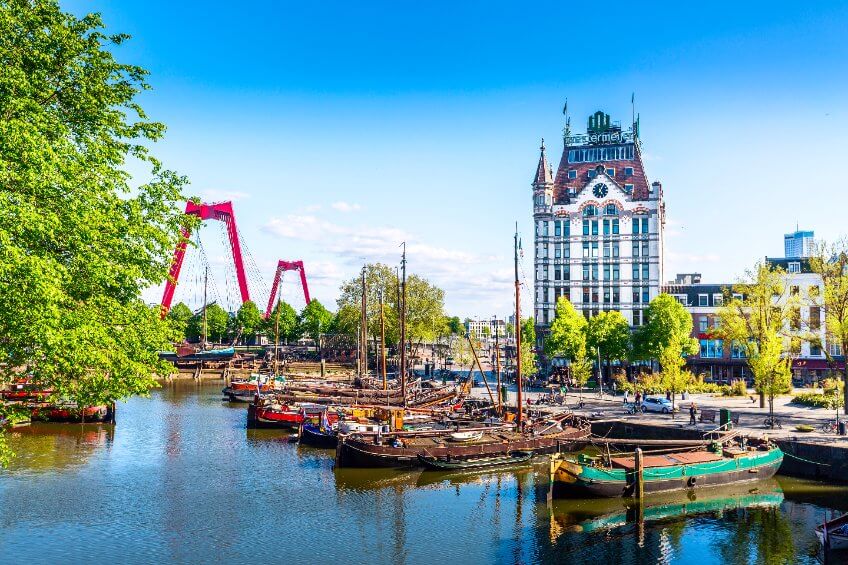
To transform its geographical location along the sea into a point of strength, The Dutch city of Rotterdam has established itself as a laboratory for smart water management, It integrates technology and green design to green its rooftops and turn them into gardens in the face of flood risks.
Throughout history, People settled on the beaches to take advantage of the economic resources and strategic locations that the seas offer, Coastal cities, which are expanding to accommodate increasing population growth, have emerged in a welcoming environment that protects both people and natural habitats.
But these cities are humanity’s first line of defense against the effects of climate change. While they are distinguished by special geographical features, faced with unique risks, As in the case of the Dutch city of Rotterdam, 90% of which lies below sea level, which, according to the description of its sons, was shaped by waters from the sea, the river, the sky and the subsoil, It left it suffering due to the flow of heavy rain and the collapse of the drainage network, Even tanks that are supposed to be part of the solution sometimes become part of the problem when they fill up and overflow.
Because Rotterdam’s location is private enough to produce creative innovations, Where the city has embraced many smart water management experiences, Such as water-absorbing gardens and artificial ponds that hold it, But all this is no longer enough, So the city authorities began to look for a solution to find an additional space that would take into account the architectural heritage left by the Second World War.
In the face of this reality, The Government of Rotterdam has launched a proactive initiative to provide financial support to residents and landlords in the public and private sectors to join the network of green and blue roofs, People’s homes and workplaces are a protection barrier for them.
This solution builds on a characteristic that distinguishes Rotterdam from other Dutch cities, While triangular galmon surfaces are scattered throughout most parts of the country, Rotterdam has chosen flat surfaces, which together make up about 14 million square meters under which 650,000 people live.
They can install green roofs over their homes. This means that the building is partially or completely covered with plants that prevent water from seeping into the building. A move taken by thousands of residents, turning the roofs of their houses into sponge gardens, Others opted for the blue solution, which is based on equipping surfaces with water tanks with electronic drain valves that can be opened or closed remotely or, in the most sophisticated version, through a special application downloaded to smartphones. Through this solution, Each tank is connected to the rest and programmed to drain or store water automatically according to the weather forecast. To get these predictions, The government has installed weather radar on top of the city’s buildings, It is so sensitive that it is able to detect precipitation at a distance of 16 to 20 kilometers.
After more than a decade of work, The Ministry of Sustainability has officially adopted the Multifunctional Roofs Program, It also includes the option of yellow surfaces that generate clean energy from sunlight. Today, The Rotterdam government has launched a festival called “Days on the Roof”. It is a series of social events, concerts and art exhibitions that take place on the rooftops to alert people to the untapped potential of these spaces.
In general, Climate policies in the Netherlands take on the character of an emergency response, Local authorities are racing to launch smart city projects. While Rotterdam is striving to adapt, The capital Amsterdam focuses, on the circular economy, Other cities are moving to establish a low-carbon transport system, to achieve a complete transition to clean and sustainable energy, to build resistance, or to set other goals for themselves. So, The central government is keen to have a communication strategy between cities, academia, research institutions and the private sector to share experiences, ideas and challenges.
The most prominent of these challenges is the large-scale deployment of projects, There is no provision in national laws that obliges contractors to design certain surfaces, The government, which owns very few buildings, understands that the best time to green the roof is during the construction of the building. Or at least during its renovation. For now, The government provides financial support of about $350 per cubic meter of water collected by the green roof. To increase turnout, The city has launched an electronic platform and interactive maps that allow residents to verify the suitability of their roofs to the basic specifications of space, durability and durability. Choose green, blue or yellow surfaces, And see how much support they can get.
If successful, The Rotterdam experience will provide an excellent model for urban sustainability, Green roofs provide additional vegetation cover and increased biodiversity, While the blue roofs will enhance flood safety and store about 10 million liters of water, The yellow roofs will generate sustainable, environmentally friendly energy that will be enough to light 27,000 Dutch homes.
References:
https://amsterdamsmartcity.com/updates/project/resilio-amsterdam-blue-green-roofs