
In the bustling markets of Kenya, local communities have imagined an economy that doesn’t grind to a halt when conventional money runs dry. Their solution: a community-driven lifeline called Sarafu, a complementary currency that allows individuals and businesses to trade goods and services without relying on the national currency. The experiment has reshaped the contours of social and economic development.
Traditionally, national currencies are seen as symbols of strength, stability, and governance. But what happens when they fail to serve the very people they represent? In such cases, access to money becomes a privilege. Entire communities find themselves excluded from financial systems, forced to rely on ingenuity simply to survive.
This is the reality in rural Kenya, where trade links neighbours, farmers, and small businesses. Yet behind the activity lies a harsher truth: many of these communities remain cut off from formal financial systems. Banking services, credit, and even basic financial literacy are scarce. Cash flow is fragile at best.
Kenya is often celebrated for its mobile money revolution and cashless platforms. But financial exclusion remains entrenched, especially in low-income rural and urban areas. Vulnerable populations are hit hardest during crises, as seen during the COVID-19 pandemic, when even basic transactions became overwhelming challenges. According to the Kenyan nonprofit Grassroots Economics, without access to reliable currencies and banking systems, local economies cannot function effectively. Foreign aid and temporary stopgaps are no substitute for lasting solutions.
A Currency Built by and for Communities
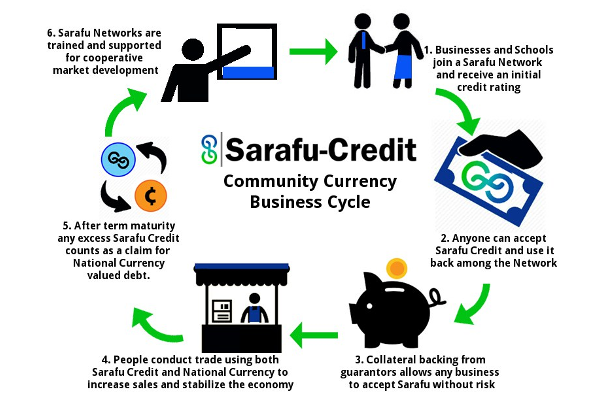
Grassroots Economics launched a bold initiative to empower local communities through alternative currencies. Working with community leaders, government officials, and international partners, they introduced Sarafu, a decentralized financial system designed for low-income populations.
The model is straightforward: individuals and businesses register via mobile phones, receive an initial balance, and begin trading within their communities. Sarafu transactions are handled through a mobile app or even basic SMS, bridging the gap between limited banking infrastructure and the widespread availability of mobile devices.
To ensure transparency and decentralized control, Sarafu leverages blockchain technology. It also promotes circular economies by encouraging trade in locally produced goods and services, reducing dependence on national and global currencies.
Building Trust, Overcoming Barriers
Trust was one of the project’s biggest challenges. How do you convince communities to adopt a currency not backed by the state? The answer lay in dialogue—ongoing workshops, conversations, and demonstrations to dispel doubts about Sarafu’s value and usability.
Technical hurdles also loomed. In rural areas with patchy internet and mobile coverage, Grassroots Economics turned to USSD technology (Unstructured Supplementary Service Data), allowing even users of basic phones to access Sarafu without constant internet connectivity.
Questions of legitimacy and regulation soon followed. As a decentralized currency, Sarafu had to navigate regulatory uncertainty. The organization engaged policymakers to establish supportive legal frameworks that could sustain the initiative over the long term.
Another obstacle was ensuring Sarafu’s circulation. Many alternative currencies fade once initial enthusiasm wanes. To prevent this, the team relied on continuous community engagement and incentives: offering discounts, encouraging vendors to accept Sarafu alongside the national currency, and promoting equal recognition of both.
A Safety Net in Action
Sarafu has transformed daily life for many Kenyans. It has strengthened local trade networks, given farmers and merchants tools to keep their businesses running, and provided families with access to essential goods during crises. More than just a temporary fix, it has become an economic safety net.
Equally important, Sarafu has helped integrate the financially excluded into a functional system, offering them a path toward gradual security. For many, it represents more than a tool for transactions: it is a symbol of innovation, resilience, and the power of grassroots action.
References:
- https://www.grassrootseconomics.org/pages/how-it-works
- https://www.grassrootseconomics.org/pages/about-us
- https://www.grassrootseconomics.org/pages/sarafu-network
- https://docs.grassecon.org/
- https://www.grassrootseconomics.org/grassroots-economists-journey
- https://www.grassrootseconomics.org/pages/food-forests
- https://www.grassrootseconomics.org/pages/research
- https://www.grassrootseconomics.org/pages/get-involved
- https://sarafu.network/