

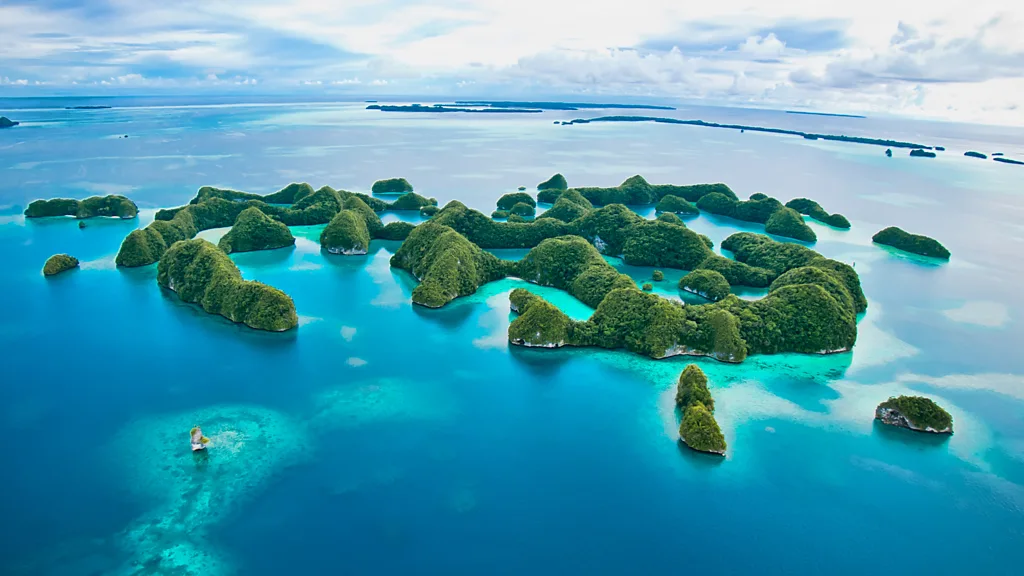
In a pioneering move that integrates legislation, awareness campaigns, and incentive programs into a unified ethical travel experience, the Pacific island nation of Palau has implemented a globally unique initiative: all incoming visitors must sign an “environmental pledge” printed directly into their passports. The text, co-written by the country’s children, commits tourists to act with environmental and cultural responsibility during their stay.
Located in the middle of the Pacific Ocean, thousands of miles from the nearest continent, the Republic of Palau is a small archipelago of just over 20,000 residents. But it chose to speak up when many others remained silent, not through slogans, but through a tiny stamp in travellers’ passports. The pledge, written as a promise to Palauan children, reads: “I take only what I need, and leave only a footprint.” This small gesture repositions border control not as a bureaucratic checkpoint, but as a moment of ethical entry, an invitation into a value-driven world, not merely a geographic one.
Palau’s pledge emerged from necessity. In 2015, the country welcomed more than 160,000 tourists, seven times its population. Tourism, while vital to the economy, was straining the islands’ fragile ecosystems and cultural sites. Coral reefs were bleaching, pristine waters were polluted, and sacred sites were reduced to photo ops. The nation faced a dilemma: how to sustain its economy without compromising its essence?
At that critical juncture, Palau launched what’s been called the world’s first “environmental immigration policy.” It didn’t rely solely on pamphlets or PR campaigns; the pledge became a formal part of the entry process. Upon passport stamping, every visitor signs the pledge, poetically phrased and addressed to future generations. An educational video shown on incoming flights contextualizes the pledge, explaining Palau’s unique ecosystem and how individual behaviors affect its delicate balance.
But this symbolic gesture is only one part of a broader system. The Palau Legacy Project, a local organization, was created to evolve and expand the initiative. Legal restrictions now ban environmentally harmful products like reef-toxic sunscreen. Environmental fees fund conservation efforts, and tourism businesses must earn sustainability certifications under the “Business Pledge” to receive official recognition.
The results were swift. Over 96% of tourists reported an increase in environmental awareness due to the pledge, and 65% said they reminded others of its principles during their stay. The initiative has drawn global media attention, amassing over 1.7 billion media impressions, and becoming a benchmark in ecotourism policy. Inspired by Palau, places like New Zealand and Hawaii have begun adapting similar models, proof that the approach is replicable without losing its authenticity.
Palau’s true innovation may lie not in the policy itself, but in the language it chose. The government didn’t lecture visitors; it invited its children to speak. The tone is not authoritarian but aspirational, not a warning of penalties, but a call to conscience. This emotional framing redefined the relationship between tourist and local not as opposing roles, but as partners in protection.
In 2022, Palau added another layer: Ol’au Palau, a points-based incentive system. Tourists earn rewards and access to exclusive, resident-only experiences by practicing sustainable behaviors, like using reef-safe sunscreen or visiting cultural sites with local guides. This flips the transactional model of tourism. Access is no longer purchased; it’s earned through responsibility.
Palau proves that small nations can lead with bold ideas. When resources are limited, creativity becomes essential. When nature is vulnerable, values become non-negotiable. Palau has reimagined tourism not as a commodity, but as a covenant. Travel, here, is not just about movement through space, but a passage into cultural and ethical awareness.
The deeper lesson is that environmental policy need not remain confined to summits or white papers. It can live in everyday details, a stamp in a passport, a promise written by children and read by adults. Palau shows how political will, fused with moral imagination, can redirect entire sectors not just tourism, but how we relate to place, and to responsibility.
In a world where nature is consumed at unsustainable speeds, and travel is often exercised as a right with no corresponding duty, Palau reminds us: true hospitality begins with the understanding that the Earth is not owned by its visitors but held in trust by its residents. And that the most transformative journey isn’t always to a new place, but to a new state of awareness.
References: