
In Northern Europe—where long, harsh winters collide with abundant renewable energy—an innovation is reshaping how heat is stored and used. Finnish engineers have unveiled a breakthrough that turns one of the most common materials on Earth into a thermal battery: sand.
The global race to stabilize energy supply from renewable sources has underscored a dilemma: how to guarantee reliability when the wind doesn’t blow and the sun doesn’t shine. Fossil fuels, for all their environmental damage, have always been dependable on demand. Renewables, by contrast, ebb and flow with the weather—soaring when skies are clear or winds are strong, collapsing when clouds gather or breezes fade.
This mismatch often runs counter to demand. During surplus production, grid operators are forced to curtail output. At peak demand, renewable generation falls short, forcing reliance on fossil fuels. Conventional batteries help, but they are costly, space-intensive, environmentally burdensome, and limited in storage capacity.
The challenge is especially pressing in countries with long, cold winters—like Finland—where the gap between renewable generation and actual heat demand is stark.
Turning Sand into Storage
Recognizing this need, Polar Night Energy approached the storage problem from a new angle: harnessing the thermal properties of ordinary materials. Their solution is elegantly simple and surprisingly powerful: sand.
The choice wasn’t just about abundance. Sand has a high heat capacity and low thermal conductivity, allowing it to absorb and retain heat effectively—at temperatures reaching up to 500°C.
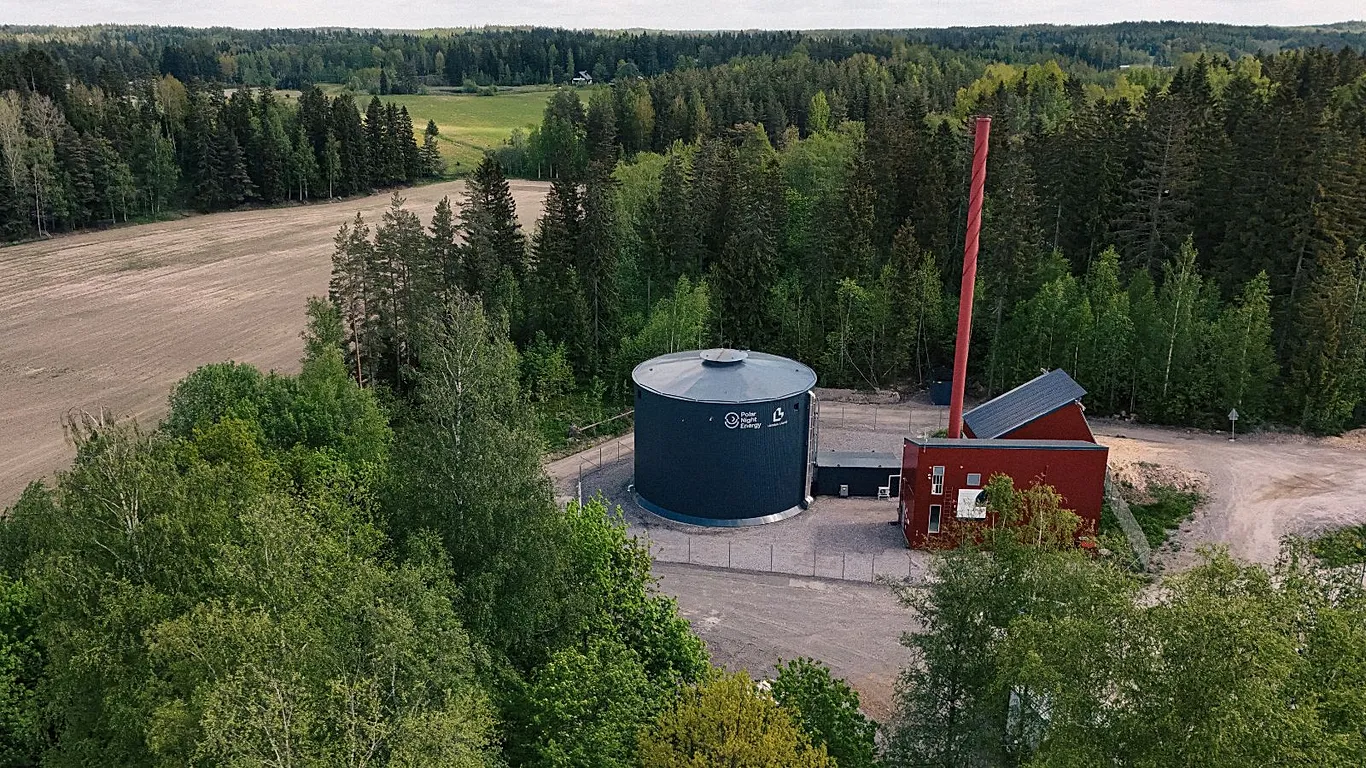
When renewable generation exceeds demand, surplus electricity powers a system that heats a massive volume of sand contained within a heavily insulated silo. The sand stores the heat with minimal loss, keeping it for days, weeks, or even months.
When needed, ambient air is circulated through the hot sand, absorbing the stored heat before passing through a secondary heat exchanger. This transfers thermal energy into an existing district heating network, delivering clean heat to residential, commercial, and public buildings.
Smart Heat Management
Behind the simplicity lies a sophisticated control system. Polar Night Energy uses advanced computer modelling to manage how heat flows through the sand mass. These models optimize charging and discharging cycles, ensuring efficient storage and reliable delivery.
While current deployments focus on direct heat, researchers are also exploring ways to convert the stored thermal energy back into electricity—a development that could vastly expand the technology’s potential.
Engineering Challenges
No breakthrough comes without obstacles. Designing a system that can absorb intermittent renewable surpluses and release heat consistently required careful engineering. The silo must maintain extreme internal temperatures around the clock. Storage materials must withstand repeated heating and cooling cycles without degrading. Even sand must be tested for purity and performance, as industrial byproducts like crushed rock behave differently.
The digital models that govern heat flow and predict availability require constant calibration. Balancing speed and efficiency is another challenge: the system must store energy quickly during periods of surplus, then release it steadily during peaks, minimizing losses.
Early Results, Big Promise
Prototypes and early simulations have validated the concept. In the Finnish town of Pornainen, the sand battery is projected to cut carbon emissions from heating by 70%. By reducing reliance on fossil fuels and firewood, it boosts grid stability and enhances renewable energy integration.
The design also embodies circular-economy principles: sustainable materials, low costs, and scalable deployment. Because sand is universally available, the approach is both adaptable and expandable, offering communities energy independence and insulation from global market volatility.
Perhaps its greatest strength is simplicity. Built from materials found almost anywhere, the sand battery has the potential to ignite a quiet revolution in how societies interact with energy—making renewables not just clean, but also consistently reliable.
References: