
To improve the worsening state of transportation infrastructure exacerbating pollution, the city of Santiago in Chile embarked on a transformative journey, involving the revitalization of the transportation fleet with modern and eco-friendly buses. The goal is to develop innovative transportation solutions aimed at enhancing the daily lives of its residents.
Public transportation systems possess the capacity to either shorten or significantly extend perceived distances. In some countries, these systems play a pivotal role in shaping individuals’ trajectories. For example, a train can facilitate a student’s access to a distant college, while a bus route can help an unemployed person reach avenues for job opportunities.
The importance of the public transportation system in the Chilean capital, Santiago, with its 7 million inhabitants representing 40% of Chile’s population, makes it one of the largest metropolitan areas in South America, surrounded by mountains. Every day, 6,800 buses traverse the city streets, maintaining its vibrant life. However, these buses are currently facing a crucial turning point as they have reached the end of their expected useful life. This has reduced service quality, hindered passenger operations, and led to increased pollution, noise, and traffic accidents. The authorities are confronted with a significant challenge that threatens the city’s quality of life.
Santiago has ranked among the most polluted capitals in Latin America since the early 1990s. Previous statistics indicated that air pollution caused premature deaths of over 4,000 people annually, imposing a heavy burden on the healthcare sector, costing approximately $670 million. The problem peaked in 2015 when 1,300 companies were forced to close, and 40% of vehicles went out of service following the declaration of an environmental emergency.
Faced with this complex situation, the Santiago government initiated a journey to renew the transportation infrastructure, aiming to achieve a sustainable and efficient system. Being an emerging economy and lacking domestic production of modern, eco-friendly buses, the local government of Santiago had to formulate a distinctive strategy. Advanced vehicles in their society are associated with high income. Therefore, they chose a gradual reform process that led to the launch of the updated public transportation system. This system consists of 350 routes covering 2,946 kilometers, operated by 6 private sector operators, accommodating 6,756 buses with an operational capacity exceeding 690,000 passengers.
In 2011, the government began launching pilot projects and conducting evaluations of routes and bus performance. For example, they developed a model driving course tailored to Santiago’s natural landscapes. They also specified technical requirements and minimum operational requirements for the fleet renewal tender. These efforts led to the establishment of a broad partnership led by the Ministry of Transportation, involving governmental and private entities, to secure operating and maintenance services. Agreements were signed to provide renewable energy at a reduced rate, creating a dedicated electric bus lane along a major axis in Santiago, Avenida Grecia. It features 40 stations offering free internet and phone charging, with informative boards displaying schedules. Some stations include exclusive payment points. Each station is equipped with its own solar energy system, covering its lighting and equipment needs. All stations facilitate easy access to services for wheelchair users.
In 2018, Santiago adopted the European emissions standard, the sixth standard, before any other Latin American city. It banned vehicles that did not meet the fifth standard and imposed taxes on drivers based on nitrogen oxide and carbon dioxide emissions. The difference between the two standards is that the sixth standard obliges vehicle owners to install particulate matter filters, reducing up to 90% of these emissions.
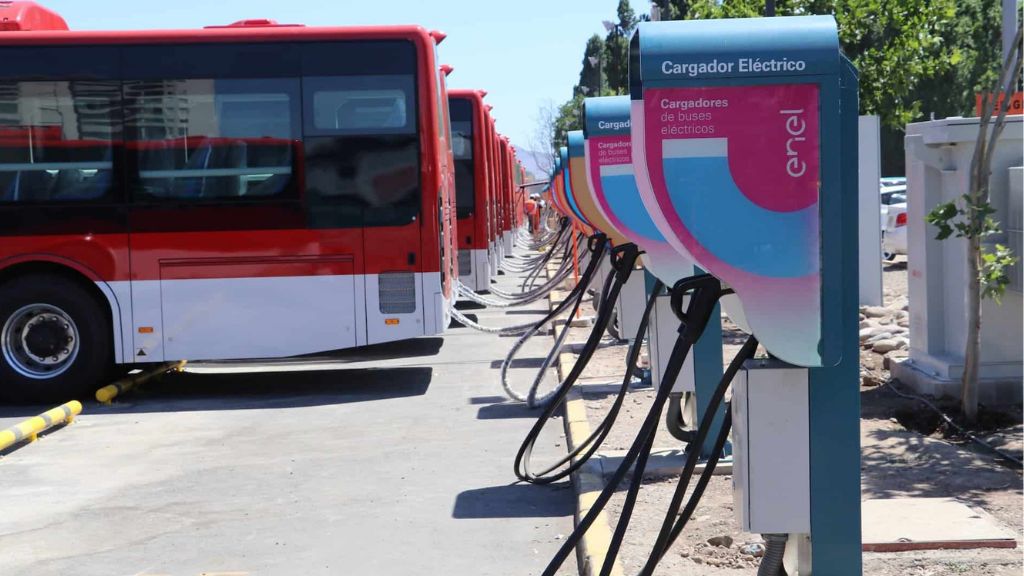
This paved the way for the introduction of 400 electric buses, approximately 6% of the public transportation system, alongside 600 buses meeting the sixth European standard. This qualitative leap presented a series of challenges. First, managing an abundant import process was challenging due to Chile’s trade agreements with China, the European Union, and the United States, offering flexibility in selecting suitable prices. The new business model separated bus ownership from its operation and maintenance. Private sector operators purchase the buses and provide them to public sector operators through a leasing contract regulating the relationship between the partners.
The second challenge involved investor concerns about the funds that operators should repay, especially since the new business model allows any third party to purchase and operate the buses. To address this, the Ministry of Transportation provided precautionary guarantees to cover investment costs in case any operator failed to fulfill its commitments.
The system did not escape criticism regarding the workforce’s size and the difficulty of managing these buses alongside the original workload. Additionally, legal issues related to the long contract duration with operators have been raised. Authorities need to implement various fundamental reforms, including staffing administrative and operational departments separately to manage modern buses and establish new contracting foundations for shorter periods, i.e., 14 years for electric buses and 10 years for diesel buses. Incentives should be offered to encourage employees and investors.
Away from Santiago, the Chilean government’s task may be more complex in cities and towns lacking official public transportation systems. Numerous stakeholders and difficulty implementing changes, coupled with investor reluctance to attempt the transition, make the mission of the central government more challenging. It requires additional effort to replicate the Santiago experience and its electric bus fleet, which was ranked the largest outside China in 2019.
After years of effort, Santiago has set numerous records, introducing innovative managerial and executive solutions and serving as a model for other cities. Its goal is to shift to a completely electric public transportation system by 2035.
References:
- https://c40.my.salesforce.com/sfc/p/#36000001Enhz/a/1Q000000kW6c/knYCd6z53PMEDuWdggFpR0kinupp_K30zr8Bmes4r.8
- https://govinsider.asia/intl-en/article/how-santiago-became-one-of-the-first-cities-to-electrify-public-transport-at-scale
- https://www.c40knowledgehub.org/s/article/How-we-made-e-bus-a-reality-in-Santiago-Chile?language=en_US