
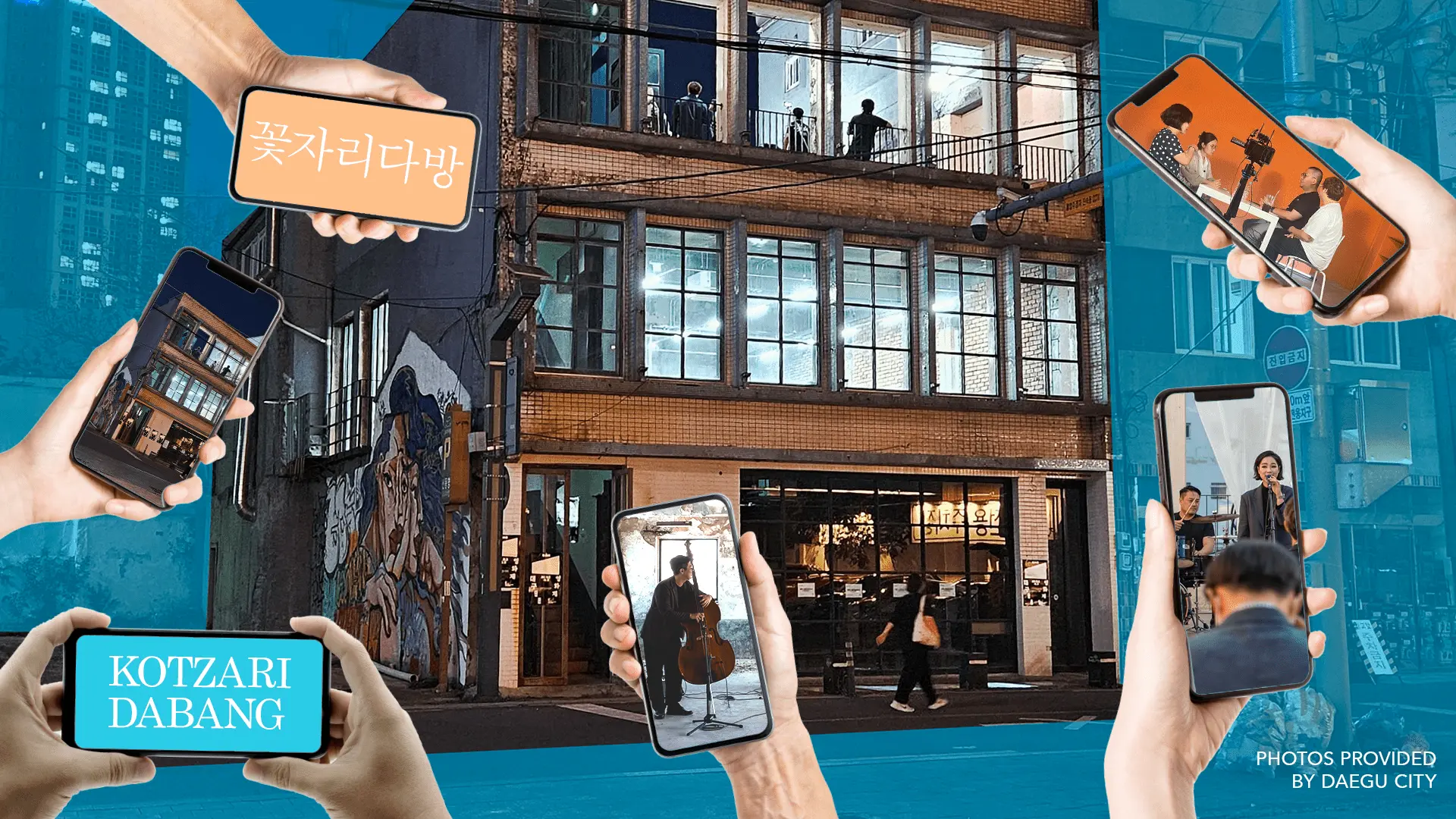
Faced with mounting urban challenges, one South Korean city has launched an ambitious experiment to reimagine what public space governance can look like. Through a participatory digital platform, residents can now propose and vote on new uses for public areas—bypassing traditional bureaucracy and enabling communities to shape their own environments. What began as a local trial has evolved into a forward-looking model for civic governance, merging technology, sustainability, and bottom-up participation. It signals a broader shift in how we think about cities—not as static infrastructures, but as dynamic, citizen-driven systems built from the ground up.
In Daegu, South Korea’s fourth-largest city, a new understanding of “public ownership” is taking shape. Sidewalks, plazas, and parks are no longer just municipal assets managed from above—they’re becoming sites of democratic experimentation. The city’s initiative, titled “Re:Permissioning the City,” empowers citizens to not only suggest how public spaces should be used but to lead in executing and evolving those ideas.
Daegu launched this initiative as a direct response to the pressures gripping major cities worldwide: housing shortages, climate stress, rising inequality, and community fragmentation. It represents a radical rethinking of urban planning—shifting authority from central institutions to the people most affected by urban design.
At the heart of the effort is a digital platform that functions like an open marketplace for civic imagination. Any resident can propose an activity in a public space—hosting a cultural event, setting up a community kitchen, launching an environmental campaign, or organizing a bike repair workshop. Once submitted, these ideas are made public, where other residents can vote, provide feedback, and elevate proposals they support. The process mirrors the interactive dynamics of social media—but in service of urban transformation.
From Bureaucracy to Collective Intelligence
Technically, the system is simple: an intuitive interface, a blend of open and pre-set proposal categories, and a participatory voting mechanism. But socially, it upends decades of top-down control over public space—long seen as an extension of political or administrative authority. Instead, space becomes fluid and negotiable, shaped by collective creativity and evolving community needs.
The project is backed by a robust institutional partnership. Daegu’s city government provides the physical testing grounds, starting with two repurposed cultural sites that now serve as civic laboratories. A nonprofit organization focused on urban innovation co-develops the digital platform and ensures the project stays grounded in social cohesion without stifling experimentation. The initiative also emerged as part of the 2021 Bloomberg Global Mayors Challenge, which recognized Daegu as one of its “Champion Cities”.
Why Now?
Traditional models for managing public space are increasingly out of sync with the speed and complexity of today’s urban life. Overly centralized systems result in long approval timelines, exclude citizens from decision-making, and often produce sterile spaces that fail to inspire or engage. In marginalized neighborhoods, the consequences are harsher still: spaces become doubly neglected—physically and symbolically—alienating residents from their own communities.
In contrast, Daegu’s model restores agency to citizens. With the right tools, platforms, and institutional support, people become more than passive users of urban space—they become co-creators. Public spaces shift from being fixed locations to living infrastructures that carry collective memory, foster social ties, and become laboratories for shared living.
Flexibility as a Feature, Not a Flaw.
One of the initiative’s strongest assets is its built-in flexibility. The platform doesn’t prescribe what’s acceptable or not. Instead, it invites innovation. A plaza might host an art exhibit one week, transform into a community garden the next, and become a pop-up food distribution site after that. This dynamic use of space prevents stagnation and allows the city to remain responsive and alive.
Environmental monitoring is also woven into the platform. Sensors embedded in public areas track air quality, energy usage, and traffic density. These real-time data streams feed into the platform, helping inform decisions for more sustainable outcomes. Beyond physical metrics, the system can also track social indicators like community connectedness or feelings of isolation—enabling data-driven policies that better reflect lived experiences.
The implications stretch far beyond Daegu. As cities worldwide wrestle with the monopolization of public space and growing social divides, the replicability of this model becomes increasingly relevant—particularly in contexts facing refugee influxes, resource constraints, or environmental volatility. The platform offers an adaptive, low-infrastructure approach to urban innovation—scalable and context-sensitive.
Ultimately, Daegu’s experiment reveals that city-making is not only a matter of regulation, but of imagination. Laws alone won’t fix broken cities—but empowered, connected residents might. Technology here isn’t replacing relationships; it’s strengthening them. Inclusive participation becomes a prerequisite for justice, and organized flexibility becomes a strategy for innovation.
This is not just a local case study—it’s a global invitation to reimagine urban life. A city not dictated from above, but co-created from below. A city where every citizen is not just a user of public space—but a designer of it.
References:
https://bloombergcities.jhu.edu/news/city-putting-its-people-charge-public-space
https://provocations.darkmatterlabs.org/re-permissioning-the-city-unlocking-cities-growing-underutilised-spatial-assets-for-an-emergent-1550997714a4