

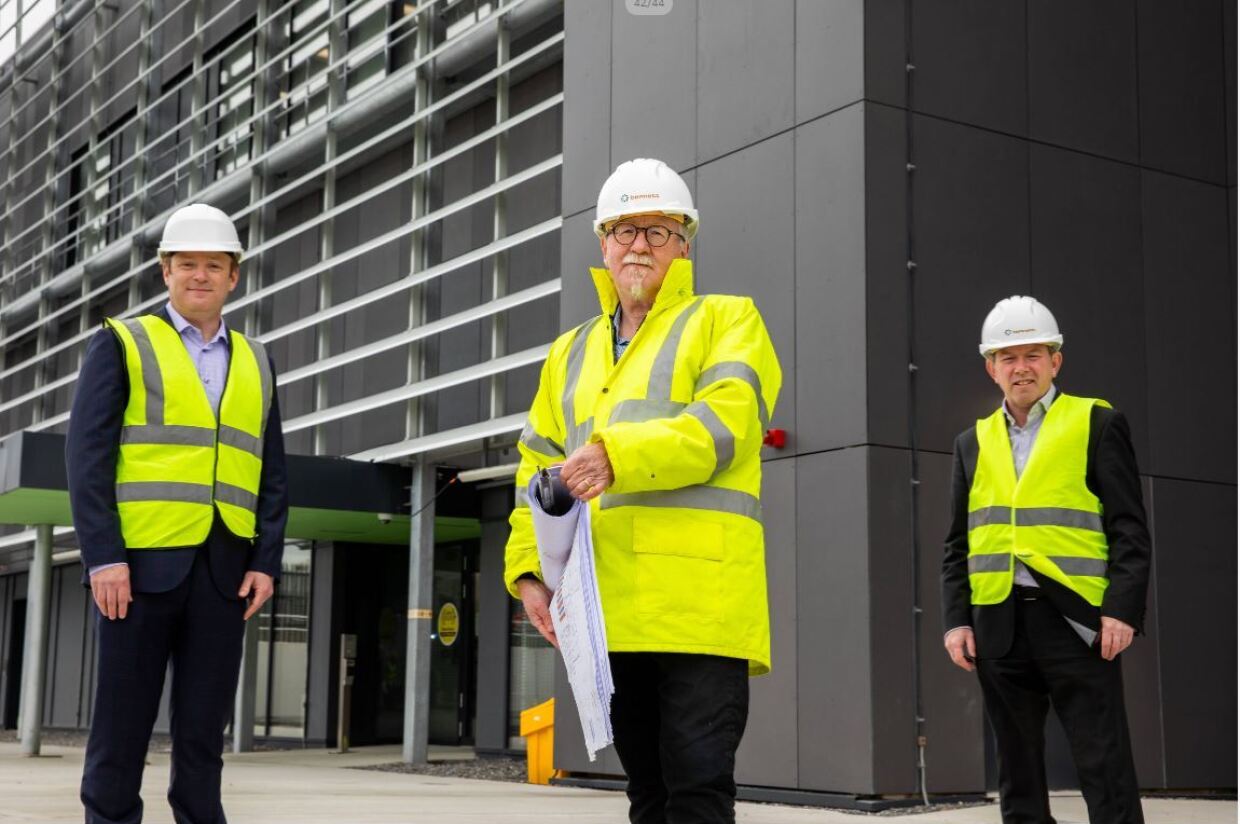
Driven by their commitments to address climate change, The Irish government is working on an innovation that harnesses the heat emitted by data centres to launch the first non-profit network to heat residents from sources based on thermal waste.
In the current era, The digital economy is based on nearly 9 million data centers spread everywhere, They are simply facilities that incorporate the systems, equipment, applications, and data that enable doing business in the modern world digitally.
Being dots that embrace thousands of complex devices that operate around the clock, Data centers are among the world’s largest consumers of energy. Cloud application centers account for about 2% of global energy demand. This percentage is expected to increase 10 times within 3 years. In traditional scenarios, Most of this energy is converted into high heat, This makes the operation of data centers conditional on large cooling systems that consume a lot of energy and cost and leave a huge carbon footprint.
This burden varies from country to country according to several data, In Ireland, 70 data centers are distributed across the country, It accounts for 14% of energy consumption, i.e. higher than the consumption of the entire Irish countryside, In a country known for years as the owner of one of Europe’s largest carbon footprints due to its cold winters, When temperatures average minus 4 degrees Celsius, Obviously, the heating sector accounts for one-third of carbon emissions. Having made the removal of carbon emissions from the heating sector a national strategic goal, The responsibility of developers to create solutions that comply with national policies and meet new construction requirements has doubled.
In a remarkable experience, South Dublin County Council worked with the local energy agency to create a district heating company. and owned by its Council, To be the first non-profit energy utility in the country.
The two partners developed a plan to heat the town of Talagh using the excess heat emitted by Amazon’s local data center to heat water up to 85 degrees Celsius. Affordable building heating and low carbon footprint.
The project was partially funded by the State Climate Action Fund and the European Union’s Heat Net programme. It seeks to promote carbon reduction practices and revamp the heating sector in northwestern Europe.
Work has begun on the construction of the facility in the center of the town in a location characterized by congestion and high demand, Its population is divided into two parts, People with high thermal loads, and those residing in close proximity to a large commercial source of thermal waste.
The first phase targeted the buildings belonging to the local council, Which are – in the tradition of projects – guaranteed customers. Then The project will expand to the University of Technology Dublin near the selected facilities, Which is currently working on expanding the sanctuary, This will facilitate the extension of the necessary connections during the construction phases. The project will also serve other vital points such as the main shopping mall and the local hospital.
In cases of extreme cold, Or what is known as peak demand, This technology can be combined with large heat pumps to balance the grid, save storage cost and meet needs.
This is not the first experiment in the world where private companies have experimented with the technology to take advantage of the heat emitted by data centers for heating. In Seattle, USA, Amazon is converting the heat of one of its data centers into giant cooling towers to heat the building. In Denmark, Meta uses the thermal energy emitted by its data center to heat the region’s freezing homes.
Months after the system starts, Experts and locals have differed in opinions about its efficiency, economic benefits and environmental impact. As part of the heat fades before it reaches the target buildings, His journey through a network of underground pipes consumes an extra amount of electricity, Not to mention those needed to operate the pumps necessary to heat large areas, The heat emitted by data centers is only 35 to 40 degrees Celsius. Conversely, Heat transfer through the air will lead to greater losses. In the same vein, This solution can be difficult to implement in rural areas where population density is low and homes are far apart. This is due to its lack of pipe networks necessary for heat transfer.
However, some studies suggest that generating power from non-conventional sources such as data centers could provide up to 10% of Europe’s total demand for heating and water heating. Many hope that research efforts will find the best ways to make use of this heat waste.
If this technique is applied appropriately, You will achieve savings of about 10% compared to other options, The capital required to operate it is 53% less than the cost of installing a heat pump, In addition to thermal storage, which allows the adoption of night electricity prices. Calculating the area required for hot water cylinders, This percentage rises to 60%, The cost of their maintenance is also low, They do not contain moving parts or central units for energy production, This makes it easier to monitor and fix bugs. As the Dublin County Heating Company is a non-profit organisation, Annual revenues will be reinvested in the network to further reduce its costs. At the governmental level, They meet regulations and policies in an effective and innovative manner.
Operational This innovation is less noisy and more efficient than traditional methods, It will reduce the carbon footprint by 1,500 tonnes per year while transferring heat to a renewable source to heat 1.6 million homes.
References:
https://www.codema.ie/images/uploads/docs/TDHS_Marketing_Brochure_for_Developers.pdf