
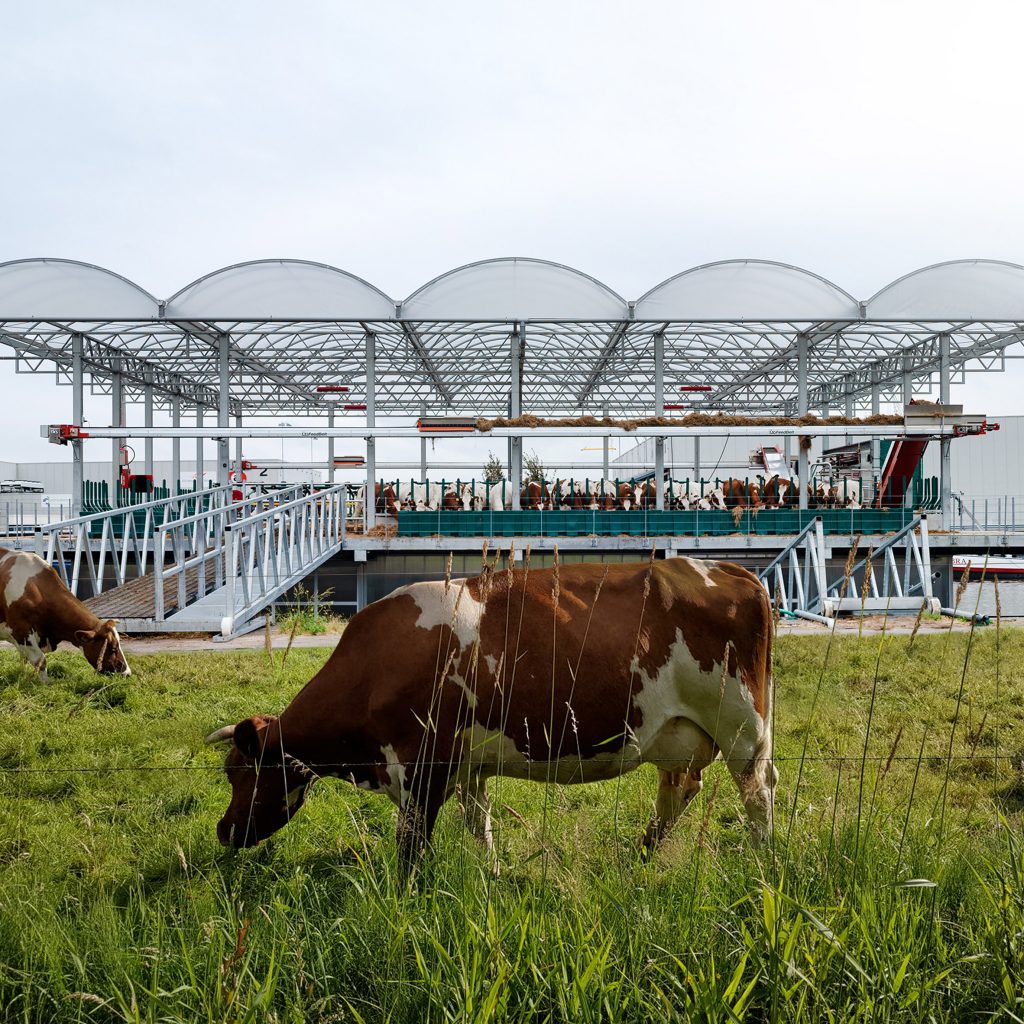
Fertile agricultural lands are becoming scarce worldwide, especially in light of climate change, which leads to increased precipitation and flooding of agricultural lands and cities. In Rotterdam, a floating farm raising cows has been developed to achieve two main goals: Mitigating the effects of climate change on food production and providing solutions to address rising sea-level challenges. The Floating Farm is part of Rotterdam’s attempts to establish a city based on circular economy, recycling, as well as recycling practices of biomaterials produced by the city to transform them into valuable dairy products. Its transparent design allows visitors to see everything that is happening inside the factory. By shortening the time required to transport the produced food to customers, the Floating Farm reduces food waste and environmental pollution resulting from transportation vehicles.
The Floating Farm project has been implemented in collaboration with the Port of Rotterdam Authority and a private architectural firm specializing in aquatic architecture. This idea came to life after Hurricane Sandy ravaged the northeastern coast of the United States. At that time, Dutch architects were developing a floating housing project in New York City when they thought of applying this technology to the agricultural field in the Netherlands.
The 89-by-89-foot Farm with the capacity to host 40 cows is made up of three levels. The cows are sheltered on the second floor and the bottom level features the machinery for processing and packaging dairy, producing an average of 211 gallons of milk daily. The top level is used to grow clover and grass for the cows to eat. As milk is processed and converted into other healthy products, cow manure is separated and reused as a nutrient-rich organic fertilizer for the city’s plants, gardens, and parks. Furthermore, the factory produces pasteurized milk and yogurt on-site.
The Farm’s architectural design ensures its self-sufficiency and complies with the circular economy principles, as it is equipped with solar panels to generate enough energy for its operation and includes a rainwater collecting and purifying mechanism to produce potable water. The cows also feed on foods grown within the city, including grain, barley, leftover potatoes, and grasses from the city’s playgrounds and golf courses. The cows then turn this waste into healthy dairy products bought and consumed by locals from the Floating Farm or shops across Rotterdam. The transparent design of the Farm was chosen so that visitors could see what was going on inside the factory, including the produced milk, the mud covering the ground, and the robots milking the cows, thus becoming an educational facility for individuals. To provide suitable living conditions for the cows, the Farm includes a spacious barn with large stalls, an automatic belt feeder, and a rubber floor, while also giving them the option to take a walk in the neighboring field.
By May 2020, the Farm became home to 32 cows. The Floating Farm is just a small part of the innovations implemented by Rotterdam, a city known for its major investments in design and technology. Hopes are high that the Floating Farm will encourage more people to consider the possibilities and opportunities offered by floating buildings. Potential future plans may involve the establishment of a floating poultry farm and floating greenhouses for growing vegetables and grasses to provide fresh food in a transparent manner and respond to customer expectations.