

to save one of its greatest national wealth from the consequences of climate change, The Australian government is exploring new methods of research and data collection by engaging the public in conducting the largest coral census of its kind.
Australia's Great Barrier Reef is the world's largest coral aggregation spread over 3,000 individual reefs covering 2,300 kilometers. It protects coastlines and provides habitat for nearly a quarter of ocean-dwelling species. Including whales, dolphins and six out of seven species of sea turtles. It is also one of the largest carbon capture sinks in the world. It is home to mangroves and seaweed that absorb and store carbon around the clock. It is an attraction for more than two million tourists annually, Australia's economy is $6.4 billion a year. It provides 64,000 jobs.
But this scientific, environmental and economic status was not enough to protect the barrier from negative influences, It remains one of the most vulnerable sites with the expansion of areas worn out by climate change. Many parts of it are unable to resist the warming of the waters, which for years have caused the phenomenon of coral bleaching. It is the natural response shown by corals to extreme climatic conditions, which may lead to his death. The 2020 Annual State of the Reef Report showed that 14% of reefs have died since 2009. This phenomenon is accelerating and expanding as climate change continues. The good news from studies, however, is that the residual is still strong, flexible and capable of remodeling. This requires serious measures to protect this UNESCO World Heritage biodiversity.
As one of the prominent community groups concerned with science, Citizens of the Great Barrier Reef launched a large-scale coral reef census project, In collaboration with the Great Barrier Reef Park Authority and the University of Queensland, Co-financed with the Australian Government's Coral Reef Fund.
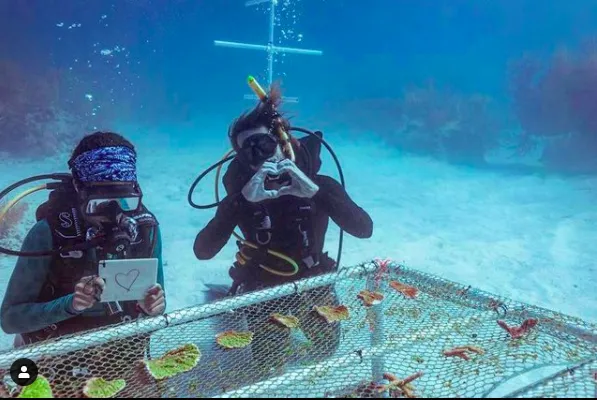
The Great Barrier Reef Annual Census project aims to test new reconnaissance methods and intensify data collection efforts. The project adopts a "citizen scientists" approach, an experiment in which the Department of Scientific Research provides scientific and technological tools to the public who volunteer to help. They are involved in designing experiments, collecting data and analyzing results.
In the Australian experience, The year 2020 witnessed the mobilization of thousands of divers, interested and workers in the fields of tourism, fishing, science and research, as well as interested amateurs to participate in the management of a temporary research fleet of diving boats, fishing, cruise ships and others. They collect tens of thousands of images from different parts of the barrier after returning to the guidelines that guide them to choose the survey areas. and how to take pictures underwater, with examples showing the required quality and dimensions, Each image should document a square that is one meter long and one meter wide. Some teams have reached the farthest points of the reef, taking more than 42,000 images from 315 coral reefs. Some are now being studied for the first time. Then Volunteers upload images online to share with interested followers from over 50 countries. The initiative receives about 1,500 visitors daily wishing to participate in research. More than half of them are from the United States of America, It is followed by Australia, Europe and Asia.
This initiative is part of the Australian Government's Long-Term Sustainability Plan for the Protection of the Great Reef in response to the recommendations of the UNESCO World Heritage Committee. Which regularly follows the sites on its list. This was the purpose of the Coral Reef Fund to be an investment program that improves water quality, restores marine ecosystems, protects threatened and migratory species, and controls populations that breed at their expense.
These experiences are integrated with other official and civil initiatives and projects, As a program "One Eye on Coral", Which manages data collection activities and provides training to qualify cadres to protect coral reefs.
While this seems to be an initiative worth developing and expanding, They remain governed by the constraints of unsecured, inadequate or irregular funding. So, A serious donor commitment is needed to continue research and recovery efforts.
On the other hand, Programs based on "citizen science" often face organizational challenges such as having enough volunteers and managing and coordinating their work. But technology offers promising solutions to this kind of challenge. Through GPS, high-quality imaging equipment, advanced computing and fast sharing tools, This project is designed to use all these and other technologies to navigate governance challenges.
During the first phase, the initiative was able to double the expected results, The volunteers collected more than 14,000 images from 170 coral reefs in 980 locations. More than a third of these images were taken on purpose-built devices. This makes it one of the largest maritime initiatives for citizen science in the world.
The Citizen Science approach helps conduct broader, more comprehensive and diverse surveys and bypass funding constraints. Also, the participation of people in research work means in one way or another providing them with knowledge.
Since this mission began decades ago, Scientists have made a great development, But this remains dependent on international efforts to limit global warming and the consequences of climate change.
References:
https://www.npr.org/2022/03/26/1088886918/australia-great-barrier-reef-coral-bleaching-climate
https://www.aims.gov.au/research-topics/environmental-issues/coral-bleaching