
In a region marked by parched land and blistering heat, residents of the historic Dunbar Spring neighborhood in Tucson, Arizona, decided to rewrite the rules. They didn’t wait for sweeping policies or billion-dollar investments—instead, they built the future with their own hands. Nearly 30 years later, their neighborhood has become a living lab for environmental sustainability—studied in universities and inspiring communities far beyond Arizona. A grassroots experiment attuned to the needs of both the land and its people.
In one of America’s hottest cities, where dust-laden streets stretch beneath an unforgiving sun, an unexpected oasis is growing. It doesn’t have a gate or a welcome sign, but step inside and you’ll feel it: a different climate altogether. Dense shade, a moist breeze, and the scent of greenery wafting through branches tell you you’ve arrived at Dunbar Spring’s “living pantry.” It’s not a forest in the traditional sense—it’s an urban space designed by locals to be much more than a patch of green. It’s a response to drought, a climate justice initiative, and a living example of what it means to live with nature, not against it.
The roots of the project trace back to 1996, when a small group of residents began planting trees to carve out pockets of shade from Arizona’s punishing summer sun. At the time, they didn’t imagine their modest initiative would evolve into one of the nation’s most effective community-driven climate adaptation projects.
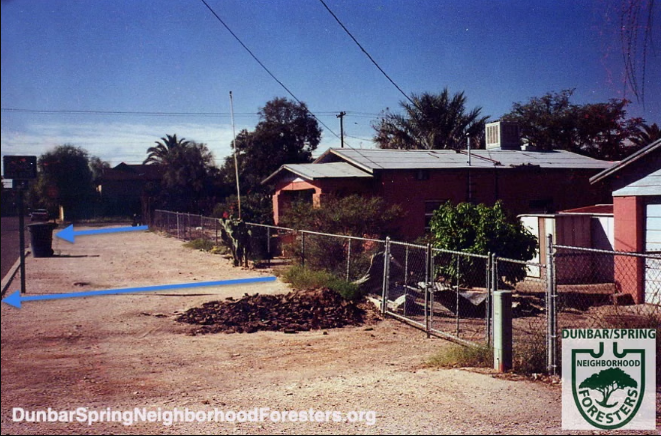
At the heart of this “living pantry” is a clever rainwater harvesting system, pioneered by Brad Lancaster, a neighborhood resident and urban forestry expert. Lancaster and his team adapted traditional techniques once used by Indigenous communities—like curb cuts that divert stormwater from the streets into small basins that nourish native trees and plants.
The result: an urban forest with more than 1,700 drought-resistant trees, including mesquite, palo verde, and ironwood, alongside native food-producing plants like prickly pear and goji berries. In some parts of the neighborhood, more than 100 plant species thrive—without a single drop of municipal irrigation—lowering ambient temperatures and improving air quality in the process.
But the project is about more than growing trees for shade. Many of the trees are edible. Mesquite, for example, produces bean-like pods that locals harvest and grind into flour at annual community events. These gatherings have become local celebrations of food sovereignty, connecting residents to the land and to each other, while preserving a culture of healthy, sustainable eating.
The science backs up what residents have long felt. On a single September day, an unshaded street in the neighborhood clocked in at 50°C. A shaded street nearby? Just 30°C. That’s a 20°C difference—thanks to trees alone. The area has also become a haven for biodiversity: birds, pollinators, and beneficial insects have returned, restoring ecological balance to a landscape that had lost it.
And yet the strength of Dunbar Spring’s transformation isn’t just ecological—it’s deeply social. This is a community-led effort in the purest sense. Residents plant, water, prune, sweep, teach, and maintain what they’ve built together.
At a time when climate change is pushing global temperatures to extremes, Dunbar Spring proves that true transformation starts at the grassroots—not in boardrooms or policy offices. It’s a neighborhood that plants knowledge the same way it plants trees—slowly, intentionally, and with care. And it shows that low-tech solutions can yield high-impact change.
In short, Dunbar Spring offers a replicable blueprint—one that other cities can adopt, provided they’re willing to listen: to the land, and to the people who live on it. As urban heat islands expand and air conditioning becomes a global crutch, this community presents an alternate path—one rooted in simplicity, reverence for water, and the co-cultivation of food and knowledge. Here, the forest is not just a place. It’s a vision for a gentler future—a patch of shade, a source of nourishment, and a living memory of roots that refuse to be forgotten.
References:
https://www.theguardian.com/environment/2023/mar/21/urban-food-forest-dunbar-spring-tucson-arizona-climate-crisis-drought
https://www.fs.usda.gov/about-agency/features/urban-food-forests
https://smileymovement.org/news/an-arizona-neighborhood-is-an-urban-forest-and-community-pantry#:~:text=A%20neighborhood%20outside%20of%20Tuscon,its%20become%20something%20else%20entirely