
In the heart of the arid Mexicali desert, the “Las Arenitas” project tells an unlikely story: wastewater breathing life into dead land. After decades of severe environmental pollution, this treatment plant has emerged as a model combining engineered systems and natural solutions. Through a carefully designed artificial wetland, the ecosystem has begun to return — proving that sustainability begins when we treat nature as a partner rather than merely a passive recipient of harm.
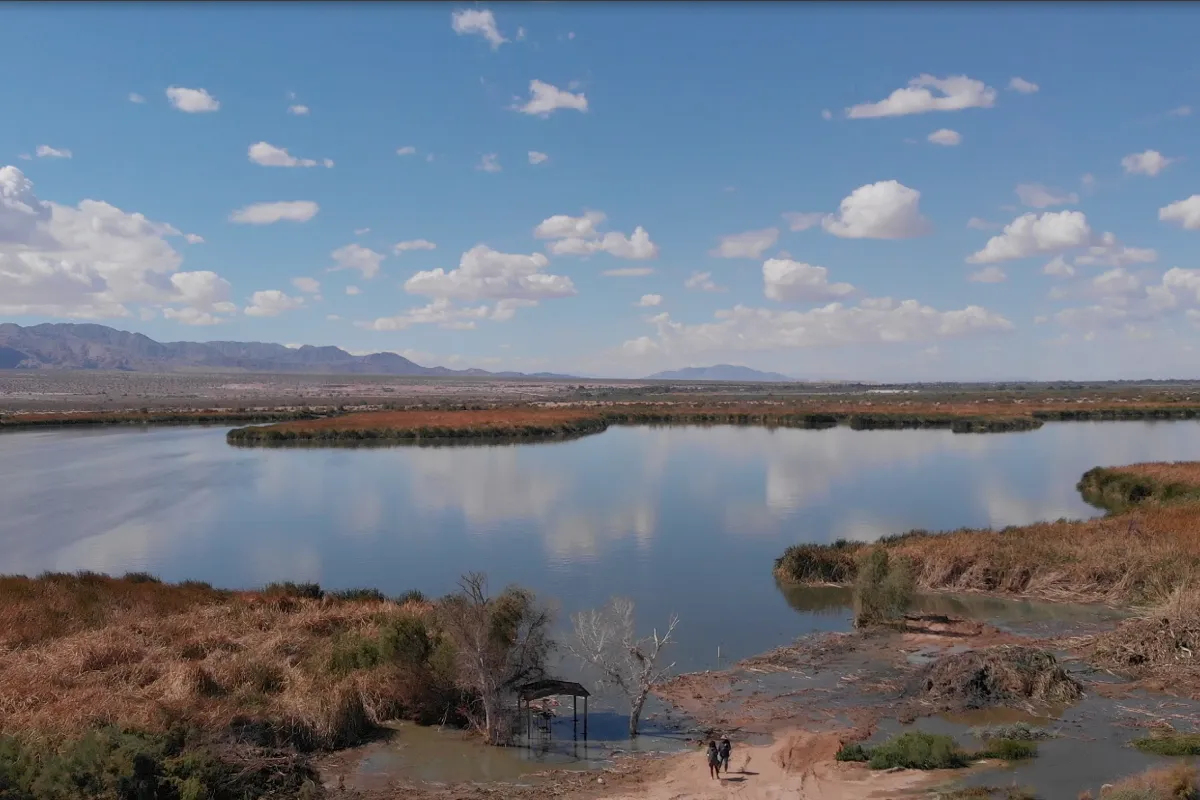
This story starts in northern Mexico, under Mexicali’s scorching sun, in a place long considered barren. It all began with a small artificial marsh beside the treatment plant, where the land started to “breathe” again, and nature began to redraw the contours it had lost decades ago, when the Colorado River once pulsed with life before suffering from mismanagement and pollution crises.
The path to success was anything but smooth. The site now home to the project was once a witness to some of the worst pollution in the region. The New River, which carries Mexicali’s wastewater toward the United States, was among the most polluted rivers in the country. Las Arenitas wastewater treatment plant, operational since 2007, struggled for years with limited capacity and frequent breakdowns, often processing volumes far beyond its design. This led to foul odors, declining water quality, and chronic strain on treatment systems.
All these obstacles, compounded by bureaucratic delays and chronic underfunding, created a challenging environment for any environmental ambition. But what changed the equation was not just a political decision or a technical fix — it was a shift in mindset: turning nature into a partner, not merely a victim.
At the core of this transformation was the design of an artificial wetland that uses native plants such as tule and reeds to finish the biological treatment of water exiting the plant. These plants act as natural filters, absorbing excess nutrients and completing the ecological cycle that begins in the plant’s mechanical basins.
Beyond the technical aspects, the project reclaimed the area’s ancient geography, creating the marsh over an old dried lakebed and mimicking the natural water flows that once fed the Colorado River delta. The site has since become an unofficial wildlife refuge, with an increasing share of treated water now diverted into the Hardy River to support ecosystems long choked by drought and pollution.
This success would not have been possible without a broad coalition of government authorities, non-profit organizations, local communities, and ecologists. Governments funded and regulated the infrastructure, while organizations like the Sonoran Institute and Pronatura Noroeste provided technical and advocacy support. Local researchers monitored the project’s impact on birds, plants, and the broader ecosystem. Indigenous communities, such as the Cucapá people, saw this ecological revival as a gradual return to a life more in harmony with land and water.
The results extended far beyond human benefit. From just a handful of bird species in 2009 to more than 160 species in recent years, the wetland has become a biodiversity hotspot in the heart of the desert. Migratory birds, endangered species, ducks, pelicans, and even hawks have returned to soar above this artificial oasis. Meanwhile, groundwater layers have begun to recover thanks to natural water retention. In parallel, water quality in the Hardy River has improved, reducing health risks and restoring hope to surrounding ecosystems.
The impact has not been limited to the environment alone. Las Arenitas has become an open-air educational space, teaching new generations that water treatment, resource management, and ecological awareness can — and should — be part of daily life.
Las Arenitas demonstrates that nature-based solutions are not primitive alternatives but advanced strategies capable of complementing, and sometimes surpassing, engineered systems. The project’s success did not lie in pumps or industrial filters, but in imitating what nature might have done had we not disrupted its balance. The experience also highlights the importance of community engagement, showing that individual behavior around water use can be as crucial as formal policies.
In a world grappling with climate change, water scarcity, and ecological collapse, Las Arenitas stands as a successful model combining science, nature, and community. It is a reminder that waste does not have to be a burden but can become the foundation for new life — if managed wisely. What began as a technical effort to combat pollution has, through vision, innovation, and collaboration, evolved into an environmental model that plants hope in the heart of the desert.
References
https://www.wired.com/story/this-artificial-wetland-is-reusing-wastewater-to-revive-a-lost-ecosystem/