

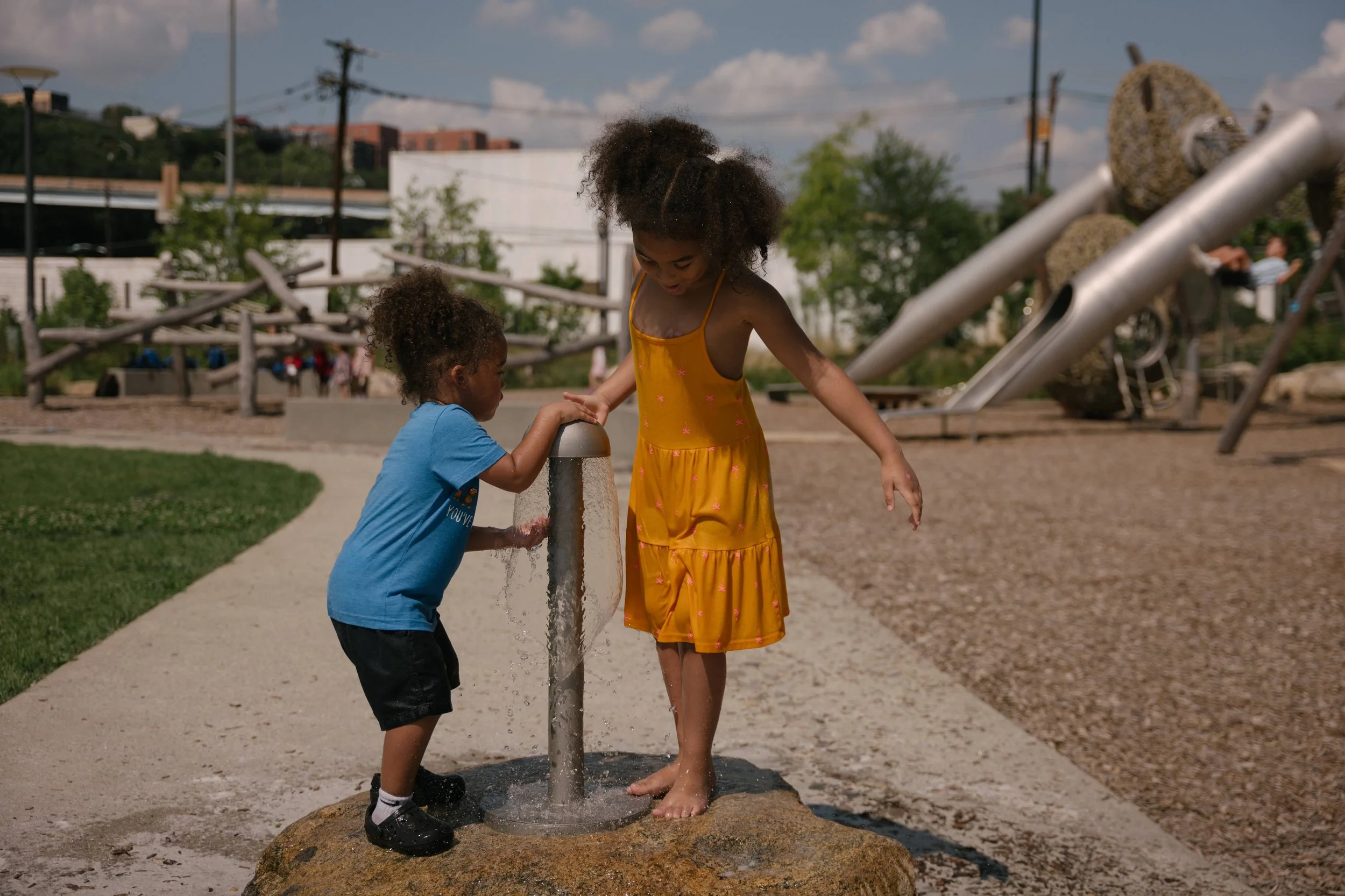
In Hoboken, New Jersey, a city long vulnerable to rising waters, a playground has been reimagined as climate infrastructure. The project offers a forward-looking model of how urban design can both protect against extreme weather and serve as a space for recreation and environmental learning. Here, a swing set and basketball court sit atop a sophisticated system that captures and stores stormwater—turning a once-flooded site into a resilient public space.
Located on the banks of the Hudson River, Hoboken hardly seemed the place where children’s play structures would double as a frontline defense against climate change. Yet after decades of chronic flooding—and especially after Hurricane Sandy in 2012, which inundated the city with half a billion gallons of water—the city knew it needed new solutions. Traditional infrastructure like drains and pumps could no longer keep pace with the accelerating risks.
The result was ResilienCity Park, opened in 2023. At first glance, it looks like any other neighborhood park: swings, slides, sports courts, and shaded trees. But beneath the surface lies a hidden network capable of storing up to two million gallons of rainwater. Combined with rain gardens, permeable surfaces, and sloped play areas that channel runoff underground, the park prevents stormwater from turning city blocks into rivers.
For a city of just 3.2 square kilometers with more than 57,000 residents, every square foot of land is precious—and every inch can either amplify or mitigate risk. Instead of isolating the solution in fenced-off tanks, Hoboken engineers and planners chose to embed it directly into the community. The park became not just a technical fix, but a living piece of climate adaptation—reclaiming contaminated land once owned by chemical company BASF and transforming it into a safe, active, and instructive space.
The system is as much about education as engineering. Visible water pathways, carefully chosen native plants, and the park’s very design are intended to demonstrate how cities can adapt to climate change. For children playing above the storage tanks, the park is both a playground and a living classroom.
Building it took collaboration. Hoboken’s municipal government led the project as part of its broader climate resilience strategy. BASF cleared toxic waste from the site before turning it over to the city. Funding came in part from the Federal Emergency Management Agency (FEMA), which contributed $10 million under its disaster-resilient infrastructure program.
Today, the park is more than a flood barrier. Families gather there, children learn and play, and the space supports local biodiversity through new plantings. The system eases pressure on the city’s overworked sewer network and prevents the destructive flooding that once swept through its streets.
Encouraged by its success, Hoboken is now planning three additional parks modeled on ResilienCity. In a city increasingly exposed to extreme weather, replication isn’t a luxury—it’s a necessity.
The lesson from Hoboken is that infrastructure doesn’t have to be hidden, grey, or purely functional. It can be green, visible, and joyful. A swing set can double as flood protection. A tree can be both shade and climate shield. A playground can hold back millions of gallons of water.
In an era of rapid climate change, Hoboken’s experiment reminds cities everywhere: resilience can be built not only in pipes and pumps, but also in spaces where communities gather, play, and learn.
References:
- https://www.ciceroindependiente.com/english/cicero-news-inside-climate-news-climate-change-environmental-injustice-flood-mitigation-playground-hoboken-new-jersey
- https://www.theguardian.com/environment/2025/jan/03/hoboken-new-jersey-kids-play-stormwater-capture-zone-playground
- insideclimatenews.org/news/27092024/hoboken-new-jersey-childrens-playground-flood-mitigation/