To rescue coral reefs from ecological collapse, researchers have developed a technique that broadcasts the sounds of healthy reefs into degraded underwater environments using submerged speakers. This process, known as eco-acoustic enrichment, revives the natural soundscape that coral ecosystems use to attract marine life—prompting fish and coral larvae to return and settle. Field trials have shown remarkable outcomes: up to a sevenfold increase in fish populations and coral settlement rates. Low-cost and non-invasive, this audio-based solution offers a new tool for ecological restoration—one that bridges science and nature to rebuild what has been lost.
In the quiet depths where reefs once pulsed with color and life, silence now dominates. Coral reefs—often referred to as the “forests of the sea”—have faced severe decline for decades due to climate change, warming oceans, pollution, and overfishing. With every mass bleaching event, reefs lose biodiversity and become ghostly seascapes, abandoned by the species that once relied on them for food, shelter, and breeding.
Faced with this unprecedented ecological deterioration, scientists have turned to an unexpected and unconventional method of revival—not by planting coral fragments or building artificial structures, but by restoring sound. Yes, sound.
In one of the most striking and unconventional conservation innovations to date, scientists from the University of Exeter, in collaboration with Australian researchers, developed a method that deploys high-fidelity recordings of thriving reef ecosystems through underwater speakers installed on the ocean floor. The aim: to lure back fish and marine larvae to areas once teeming with life but now deserted and quiet.
The initial tests took place on dead sections of the Great Barrier Reef. There, underwater speakers played recordings of bustling reef environments. The results were beyond expectations: juvenile fish returned in significantly larger numbers, and coral larvae settled at rates seven times higher than in silent control sites.
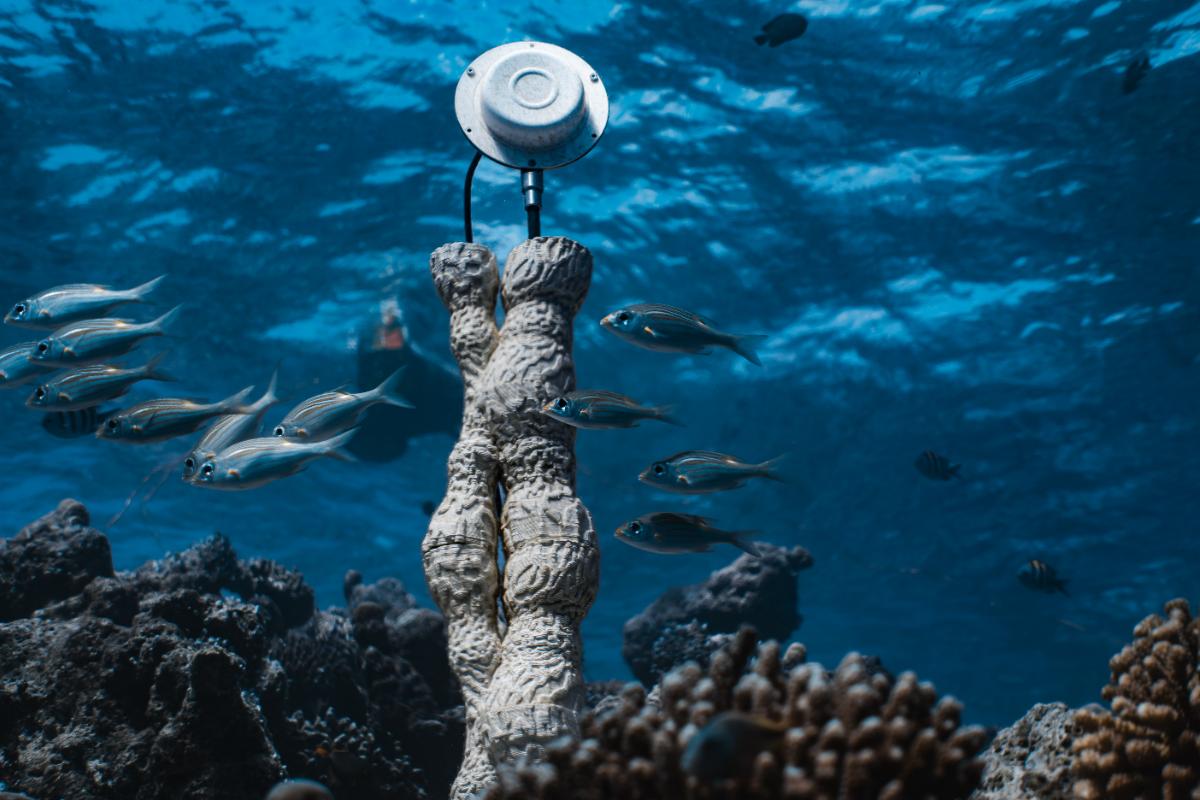
But the innovation didn’t stop at sound alone. The research teams went on to develop 3D-printed reef-like structures embedded with concealed speakers, designed to project sound evenly across the site. This blend of acoustic engineering and biomimetic design creates a richer, more immersive soundscape—more convincing to marine life seeking suitable habitats.
What makes this technique so powerful is its simplicity. Compared to traditional methods—such as manually transplanting coral or constructing large-scale artificial reefs—eco-acoustic enrichment is inexpensive, low-impact, and logistically feasible. It introduces no foreign objects, requires minimal human intervention, and instead reactivates one of the reef’s natural signals: its voice. Just as birdsong guides migrating birds on land, reef noise helps larvae of fish and coral locate suitable habitats underwater.
Unsurprisingly, the technique is gaining traction among marine reserves and conservation organizations—particularly in low-resource coastal nations. Its low barrier to deployment and demonstrable success make it a promising new addition to the global coral restoration toolkit.
But the potential reaches beyond biology. These underwater sound technologies are also being used in public outreach and eco-tourism. “Underwater sound installations” allow divers and snorkelers to listen to the living rhythms of the reef—offering a rare acoustic window into a normally unseen world. This artistic and human dimension brings people closer to the ocean in novel, emotionally resonant ways.
As ocean acidification and climate threats intensify, the need for flexible, imaginative, and sustainable interventions becomes more urgent. While sound cannot restore lost coral mass, it offers a way for nature to catch its breath and begin to rebuild. When fish return, when larvae settle, and when food webs begin to re-emerge—not through construction, but through remembered soundscapes—a new cycle of life begins.
In an age when we strive to reduce noise pollution on land, the ocean reminds us: some noise brings life.