In a world increasingly shaped by artificial intelligence, a deceptively simple game emerging from Japan, “Deviation Game,” is making a bold statement: human creativity still holds a unique power that no machine can replicate. By nudging players to think beyond conventional cues and craft ideas that defy algorithmic imitation, the project highlights not just the current limitations of AI, but the irreplaceable essence of human expression.
Humanity has long demonstrated a remarkable ability to stay one step ahead, surviving harsh conditions, mastering the natural elements, curing once-incurable diseases, and interconnecting the globe in ways previous generations could scarcely imagine. At the core of these achievements there has always been a boundless capacity for innovation.
In recent years, artificial intelligence has made astonishing progress in mimicking human thought and actions. With techniques like imitation learning and deep learning, AI systems have evolved to predict future patterns with surprising accuracy and navigate increasingly complex scenarios, embedding themselves deeply into everyday life.
But this rapid advancement hasn’t come without concern. Ethical and cultural anxieties are mounting. Many AI systems reflect the cultural values of their developers, leading to biased or distorted interpretations of diverse human practices. Simulation models, in particular, raise red flags around consent and manipulation challenging society to reconsider the moral boundaries of machine involvement.
Enter the Deviation Game, a creative counterpoint developed by a group of experimental artists and game designers in Tokyo. The game is part of the Civic Creative Base initiative, launched under Japan’s 2023 Art Incubation Program and supported by the Creative Industries Fund.
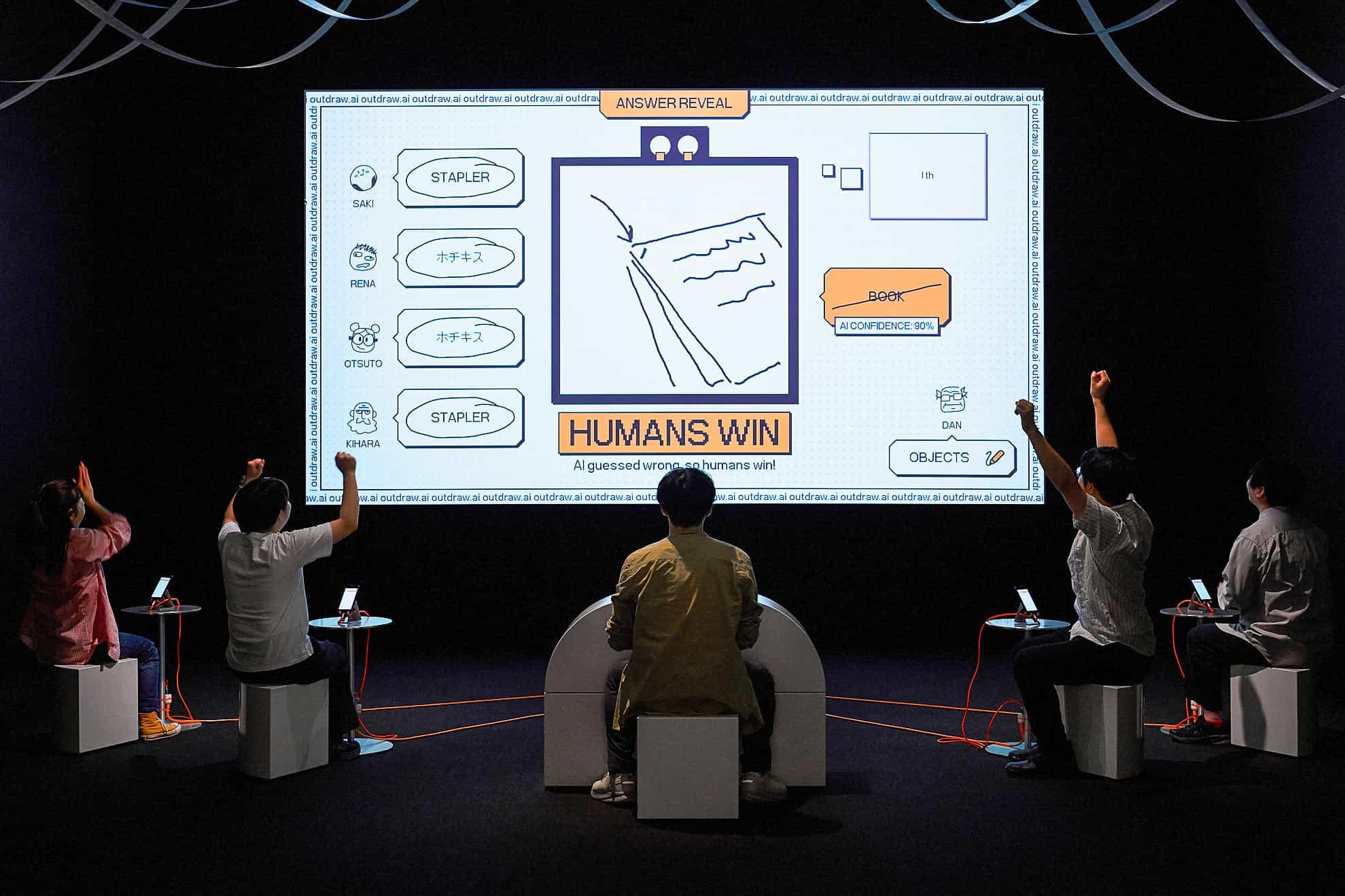
At first glance, the game is disarmingly straightforward: participants are asked to create images that are easily interpreted by humans, but incomprehensible to AI. The challenge forces players to draw upon uniquely human intuition, symbolism, and abstraction.
This latest version builds on a prior experiment called Simulation Game, using digital drawing as its foundation. In each round, two players face off: one draws an image, and the other tries to guess its meaning—racing against an AI trying to do the same. Victory lies in expressing ideas so original and so culturally nuanced that only another human can decode them.
Under the hood, the game analyzes drawings using t-distributed stochastic neighbor embedding (t-SNE), a statistical technique for visualizing high-dimensional data. The method clusters similar images while distancing outliers, highlighting how “human” the drawing is relative to machine-learned expectations.
Despite its playful format, the game faces substantial hurdles. Cultural integration is a major challenge. While the concept is globally relevant, its success depends on adapting to the cultural contexts of diverse communities, ensuring that participants from different backgrounds find it intuitive and creatively rewarding.
Scalability is another key issue. Expanding the game beyond Tokyo—to new countries, cities, or industries—requires structured planning, sustainable investment, and a deep understanding of local ecosystems. Time management, the team behind the game found, is the decisive factor in overcoming these barriers and maximizing the game’s impact.
If successful, the Deviation Game could serve as living proof that human ingenuity remains unmatched by machines. As it spreads to new settings, it invites players everywhere to rethink how they communicate ideas, emotions, and meaning—reasserting creativity as a uniquely human domain.
This playful framework has broader implications, too. It could offer new insights into consumer behavior by capturing reactions to unconventional visuals. In a political context, it might even help model voter behavior or shape policy development—fueling more imaginative, responsive governance.
Following its initial launch in Tokyo and several appearances at international festivals, the game drew the attention of the UK Games Fund, which backed the development of a digital version. The move signaled a growing recognition: human creativity still has the power to transcend the technologies it inspires.
References: