
As coral reefs teeter on the brink—battered by climate change, pollution, and overfishing, the world stands to lose not just vibrant underwater landscapes, but entire ecosystems that sustain marine life and millions of people. Enter Coral Vita, an ambitious startup that’s flipping reef restoration on its head by growing coral on land using a mix of cutting-edge techniques like microfragmentation and assisted evolution—dramatically accelerating coral growth and boosting resilience in warming seas.
In the turquoise shallows off the Bahamian coast, where coral reefs once painted the seafloor with living colour, something remarkable is unfolding. Amid the mass die-offs driven by warming waters and acidifying oceans, a surprising solution is emerging—not from the sea, but from land.
What began as a seemingly improbable idea—land-based coral farming—is now leading a quiet revolution in climate adaptation and marine conservation. At the heart of this movement is Coral Vita, founded in The Bahamas in 2019 with a radical proposition: grow climate-resilient corals on shore, then transplant them into dying reefs.
The idea was born from a shared passion for the ocean. Gator Halpern, a marine enthusiast, found a kindred spirit in Sam Teicher, his classmate at Yale’s School of Forestry and Environmental Studies. Together, they launched Coral Vita—the world’s first commercial land-based coral farm for reef restoration.
At their facility in Freeport, researchers cultivate 24 species of native coral using scientific techniques that wouldn’t look out of place in a biotech lab. One method, microfragmentation, involves breaking corals into tiny pieces to accelerate growth rates, up to 50% faster than in nature. Another, assisted evolution, exposes corals to heat and acidity in controlled settings to build tolerance to future ocean conditions.
But Coral Vita isn’t just a research lab—it’s also a public education hub. Visitors can learn about coral’s ecological value and even adopt and help plant their own coral fragment, blending science outreach with community engagement.
And the stakes are enormous. Coral reefs support nearly 25% of all marine species, protect coastlines from storm surges, feed millions of people, and anchor the economies of island nations and coastal cities alike. Yet over half of the world’s coral reefs are already gone, and if current trends continue, 90% could disappear by 2050.
The Caribbean has been hit especially hard. In this region alone, 80% of coral cover has vanished, lost to bleaching, ocean acidification, overfishing, and pollution from unchecked coastal development. As coral dies, fish populations collapse, food chains unravel, and entire coastal communities face heightened vulnerability to storms and economic instability.
Reef restoration isn’t new. But historically, it’s been limited to small-scale, in-ocean nurseries. Coral Vita changes that by scaling restoration into a commercially viable, land-based model. Controlled environments allow scientists to fine-tune temperature, salinity, and nutrients, conditions that help cultivate stronger, faster-growing coral suited for the harsh realities of today’s oceans.
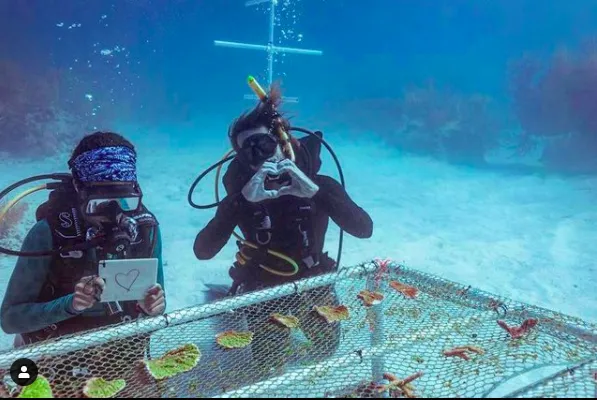
This approach sidesteps some of the limitations of traditional underwater nurseries, which are vulnerable to storms, boat damage, and predation. On land, coral can grow to maturity in safer, faster conditions before being reintroduced into the wild.
Still, the challenges are real. Building and maintaining terrestrial coral farms requires complex infrastructure, deep biological expertise, and steady funding, no small feat in a space where returns aren’t immediate. Scaling up to new regions means adapting to vastly different ecological and logistical environments and tracking long-term reef health demands rigorous monitoring and flexible strategies.
What gives Coral Vita its edge is its hybrid model—where technology meets community. By involving locals in coral farming and education, restoration becomes not just a conservation project, but a cultural one. People don’t just learn about reefs—they grow them.
And with the rise of techniques like assisted evolution, a new chapter may be opening: one where coral isn’t simply preserved but rebuilt to endure. These are corals trained to survive future oceans, not yesterday’s.
We may never bring back coral reefs exactly as they were. But Coral Vita and similar efforts show that science, when fuelled by urgency and vision, can revive even the most fragile ecosystems. Saving coral reefs isn’t just about biodiversity—it’s about protecting food systems, economies, coastlines, and the very future of life on this planet.
References:
https://www.coralvita.co/
https://www.unesco.org/en/articles/coral-vita-restoring-our-worlds-dying-reefs