
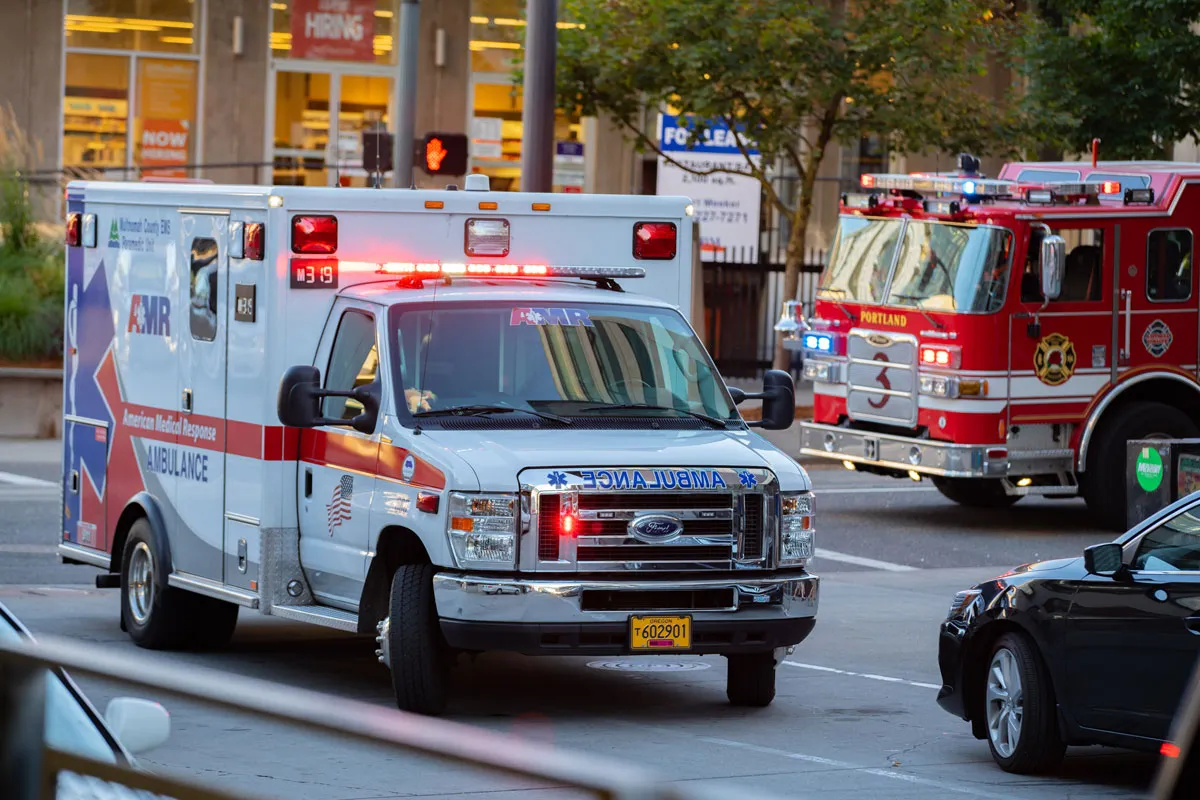
To improve the efficiency of emergency response, Many emergency centers in both Canada and the United States are using a sophisticated geographic system that allows the exact location of those seeking help to ensure that relief teams are directed to the correct address.
The difference between life and death may be again, Frontline workers in rescue and emergency systems around the world are perhaps the most aware of the value of time in saving lives.
When an emergency occurs, Those affected rush to call for help by phone, Their communications are diverted to first responder staff trained to gather as accurate information as possible about the situation, its victims, its level of severity and, most importantly, Place.
In North America, This can be a difficult task, Sometimes callers don’t know where they are, As in cases of kidnapping, Other times, They cannot activate the location feature on their mobile phones or even follow the instructions they receive over the phone, Even the technology of positioning through coverage towers does not always give accurate results, Its capacity does not exceed the identification of an area that may extend for several kilometers, Also, these towers are not spread with the same density everywhere, This is confirmed by the number of victims who lose or die while carrying out activities in nature such as walking, climbing or fishing. Even if they could call the emergency services, They will often not be able to find a single marking point, such as a building or sign, that will help response teams find them.
The longer the rescue is delayed, the risk has increased, the injury has worsened, or the chances of survival have diminished; Therefore, emergency services in both Canada and the United States of America are establishing a new mechanism based on geographic information technology, which is witnessing new innovation every day. The most recent was a system called “Three Words” created by a company specialized in coding geolocation systems.
The system offers an easy way to take advantage of a difficult science, where the respondent can send a link to the caller, Once you click on it, The caller’s coordinates according to latitude and longitude will appear in a 3-word wording.
This system is based on a simple principle, He divides the world into small squares with a side length of 3.3 meters each and then numbers them. And because the land is 57 trillion squares of this size, Numbers have been replaced by words, And lest the latter also run out, The statistically feasible solution was to encode each square with 3 random words. Hence, The caller may be in the box labeled “Window, Book, Plate”, If he escapes danger during a call, He may end up hiding in the box “Mouse, Echo, Rock”.
If the location feature is enabled on the smartphone of all systems, The geo-tracking software will automatically convert this information into a 3-word location, Users can resort to the app to find out their location in normal situations.
After the UK emergency system has integrated this service into 85% of its operations, Canada has applied it to other police, ambulance, fire and other stations, U.S. states and cities began, Los Angeles, Arizona and Dallas, adopted in conjunction with mapping tools, It has been accredited in at least 4,800 healthcare centers, Besides fire departments, many universities, playgrounds, waterways, and parking lots.
Police stations and ambulances in Dallas have begun training their staff in the use of this technology. In conjunction with a comprehensive plan to raise awareness among the population of its usefulness and methods of use, This is currently done through social media platforms. The city government is also seeking to expand the scope of this technology and urge private partners to adopt it. It looks forward to using it in the fight against highway traffic accidents.
The next 6 months will see a trial period for this technology, To be evaluated on the basis of the challenges and impacts they face. It is likely not suitable as a major means of inferring locations, It requires an internet connection, This is not always possible.
On the other hand, After the responder receives the 3-word address and goes to inform the field team and direct them to the address, There is a high probability that he will misarrange or spell words, His accent may differ from that of the team members, which can lead to misunderstandings. A lapse of this kind means heading to another address, Which contradicts the main goal of this technique.
So, Despite all that this technology promises, Various devices recommend that you handle them with caution and as a complement to pre-existing tools, There is no substitute for it, In doing so, it will facilitate the identification of victims of violence, fire, disasters or health crises, It will make communication between different emergency teams smoother and more efficient.
This technology can create names for sites that have no names, This means reaching people wherever they are to save their lives.
References: