
Jakarta has taken an innovative approach to urban transportation by integrating diverse transport modes and streamlining operations. This holistic strategy has resulted in a substantial increase in ridership within a short timeframe, providing insights into transport solutions for other cities facing similar challenges.
The rapid growth of urban areas has created a complex interplay of social, economic, and environmental factors. As population densities rise and economic activities concentrate within city limits, urban challenges become increasingly intertwined, demanding innovative and scalable solutions.
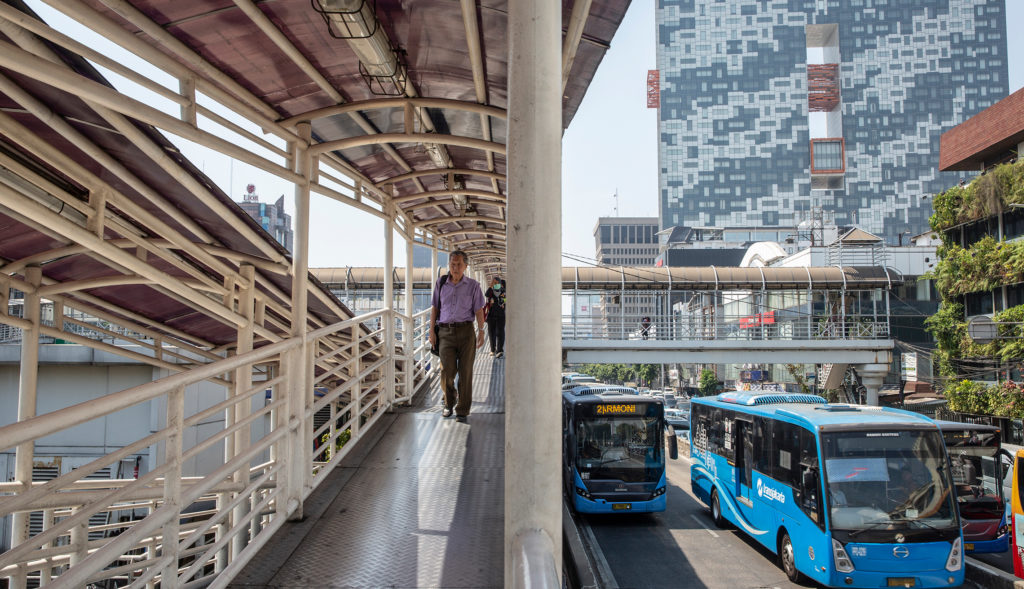
As a prime example of this phenomenon is Jakarta, Indonesia. With a population of over 32 million, the city and its surrounding areas have experienced rapid urbanization, necessitating the development of intricate transportation networks. The ‘TransJakarta’ Bus Rapid Transit (BRT) system, one of the world's longest, serves as a testament to this urban evolution. Since its inception in 2004, this extensive network has provided daily commutes for over 300,000 people across 251.2 kilometres of dedicated bus lanes served by more than 4300 buses.
This official transport system is complemented by an informal counterpart dubbed ‘angkot’ by locals. These small buses have long been part of the city’s ‘paratransit’ system, serving passengers without fixed routes or schedules. At some point, it became necessary to integrate these networks into the larger system and formalize them. Yet, this is only part of the challenge. The other part lies in the Jakarta’s air quality, which consistently ranks poorly on a global scale. This alarming statistic is primarily attributed to emissions from cars and motorcycles, which clog the city’s streets, especially during rush hour. This creates a vicious cycle of congestion, polluted air, and unequal access to transportation.
To address the city's transportation crisis holistically, the Jakarta provincial government has forged a coalition with clean transportation operators, city officials, and various transportation agencies.
Beginning in 2017, the city embarked on a project to modernize its ‘angkot’ bus fleet. By introducing safety upgrades and comfort enhancements.
For instance, the coalition developed an integrated fare system encompassing bus fleets, Bus Rapid Transit (BRT), light rail, and of course, angkot, to ensure passengers enjoy comfortable, affordable, and tamper-proof journeys payable through dedicated cards.
The initiative began as a pilot program dubbed ‘Ok OTrip’ or ‘One Ticket, One Trip’, designed for three-hour journeys. Over a ten-month period, the program gradually integrated minibuses into the formal transport system, starting with two operators covering five routes and 76 fleets. The project expanded steadily, culminating in a network of 21 routes accommodating 497 fleets.
Through this initiative, Jakarta is piloting an innovative local operational model, transitioning drivers to a holistic system under a unified operational plan. Binding contracts have been established, outlining the partnership and guaranteeing a fixed monthly income for the drivers, determined by distance travelled rather than passenger count. These legal documents stipulate a daily mileage cap of 200 kilometres and outline safety, comfort, and accessibility standards, specifying penalties for violations. Drivers are also eligible for loans to upgrade their vehicles, which “TransJakarta” commits to maintaining. This system is complemented by direct monitoring tools, such as cameras and GPS, to enhance passenger experience and monitor driver behaviour.
To complement these measure, the government has implemented initiatives such as ‘park-and-ride’ facilities, established near rapid bus stations, to encourage a shift from private vehicles to public transportation for commuting to the city centre. Additionally, the government has introduced an ‘odd-even’ traffic policy, which is designed to restrict vehicle entry into the city based on the date's parity, and a car-free Sunday initiative, which includes public activities and awareness campaigns.
Furthermore, a project is underway to fully electrify the entire fleet, with 1000 electric vehicles already in operation by the fall of 2023. The goal is to achieve a completely electric fleet by 2030.
Anticipating potential resistance or apprehension from stakeholders regarding the transformation, the Jakarta government engaged in ongoing dialogues with various interest groups. Public opinion surveys were conducted, and avenues for open discussion were established to ensure a just transition for all. Moreover, the government collaborated with stakeholders to develop plans, monitoring metrics, and evaluation criteria.
By standardizing costs, schedules, routes, and operational procedures, the integrated system has expanded public transportation accessibility, reaching 82% of the population in 2021, a notable increase from 42% in 2017. Over the same four years, daily ridership surged from 300,000 to over 1 million, with minibuses accounting for 60% of this ridership. This innovative urban planning initiative presents a unique case study that can offer valuable lessons for other cities.
By adopting a phased, holistic, and strategic approach, cities can not only enhance their public transportation systems but also address broader issues such as congestion, pollution, and equitable access.
References: