
Singapore is witnessing the launch of the first-of-its-kind on-demand delivery experience, Using self-driving robots that roam the streets to deliver orders and packages to consumers. The public-private partnership project aims to test robots and gain a clearer perception of the challenges that may hinder the provision of these services.
The delivery services sector has witnessed unprecedented growth over the past years, Especially with the outbreak of the COVID-19 pandemic and its restrictions on movement, Specifically in the field of delivery of food and household items, foods, medicines and similar daily consumables. The recent inflation of e-commerce activities has further complicated this. The gap in the provision of delivery services between vendor supply and customer demand has become significant. With the expansion of urban development in Singapore from shopping malls and new residential complexes, Many opportunities have emerged for growth and investment in the delivery sector, But they remain limited by some challenges, Especially in the "last mile" stage – that is, the last stage of transporting parcels from the nearest distribution point to the consumer – the most important of which is traffic. And multiple points for loading and unloading parcels before final delivery.
For this reason, Singapore hopes to break new ground by the end of its pilot project, which is led by the Communications and Information Technology Development Authority (ITDA). In cooperation with the Housing and Development Council, Land Transport Authority, and the Urban Redevelopment Authority. The project also includes partners from the private sector, Led by Singapore-based OTSAW, It is the manufacturer of autonomous robots that specialize in security, delivery and sterilization solutions based on artificial intelligence and cloud computing, as well as some stakeholders from the logistics sector and a major Singaporean supermarket chain.
The experiment is used, which will be implemented to serve 700 homes in seven residential complexes in the neighborhood of "Bangol" for one year, Robots to transport parcels and everyday purchases to consumers. The project aims to test the effectiveness of the technologies used in these robots on the ground, Such as the self-driving system, detect and avoid obstacles, In addition to evaluating the supporting infrastructure, of communication systems and road networks, And the extent to which robots in general succeed in accomplishing the delivery tasks assigned to them in a way that ensures consumer satisfaction. At the end of the experiment, the robotics connection system can be a model for a successful business will be assessed. Meets both consumer and investor requirements during the "last mile" phase, In terms of speed, accuracy and quality.
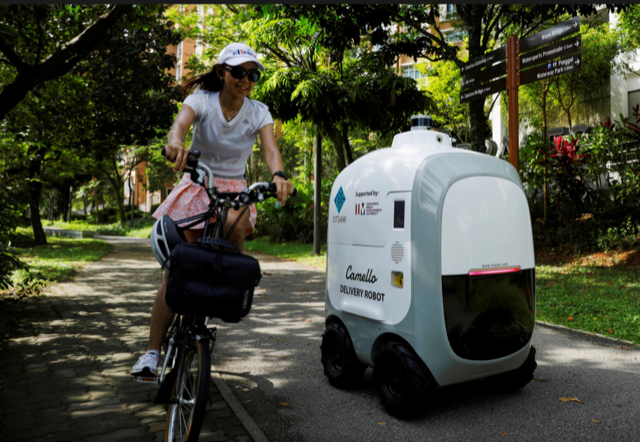
The robots used in the experiment are of the "Camilo" type, which is specially designed for "last mile" purposes of conduction. It is a small vehicle with independent wheels that operates a special system to steer the wheels separately from each other to provide them with the flexibility necessary to overcome road obstacles. The robots are also equipped with a LiDAR device that can determine the dimensions by calculating the time it takes for the laser beams from the moment they are launched to the moment they return to the sensor after reflecting on the various elements of the road. In addition The robots are equipped with a sonar camera, a dynamic obstacle avoidance system and an accurate route marking. The robot contains, which weighs 80 kilograms of blank, On two rainproof compartments with a combined capacity of 100 liters.
The maximum speed of the robot is set at 5 km per hour, equivalent to the average pedestrian speed on the road, This is after consultation and fulfillment of public safety conditions by the Land Transport Authority. But in anticipation of anything that may occur during the delivery trip, A safety officer will accompany the robot on all flights during the trial period to monitor it. The experiment will help detect any weaknesses in the delivery of the service, Whether technical, logistical or other, This enables the project to address it before the idea is put forward for wider adoption.
The service allows customers to choose when they want to receive their purchases, It uses an application that is installed in the user's mobile phone that informs him of the robot's direction to deliver his purchases, The user is then notified when the robot arrives at the building. The app sends the shipment's "QR code" – or "one-time password" (OTP) – for the recipient to scan on a screen installed on the robot. On the basis of which the compartment is opened to receive the shipment, This is to verify that the recipient is the owner of the parcel.
The "last mile" operations in logistics are the most complex and expensive. It is often the weakest link in the service chain, Especially when the demand for the service increases. One study indicates that the cost of shipping and delivery during the "last mile" constitutes about 53% of the total costs of these services. This negatively affects the profit margin and competitiveness of delivery companies. On the other hand, Delivery companies suffer from cases where the delivery process does not take place for various reasons, including failure to inform the recipient in advance of the date of arrival of the shipment, or the recipient is absent from being present to receive the shipment on time, or the delay in the arrival of the shipment and the failure to wait for the recipient, or an error in address data, or others. This also reflects negatively on the efficiency of operations, and raise their costs, It also harms the reputation of the company and its relationship with customers. But the robotics pilot project promises to address these challenges. Whether in terms of reducing the costs of operations for the benefit of companies and customers together, Or to ensure higher accuracy in the delivery of shipments to customers, In pursuit of sustainability and competitiveness in the sector, Meet the growing demand in the Singapore market, as well as support the growth of e-commerce and online shopping.
The Singapore government believes that using technology to find alternative methods such as providing an innovative and efficient delivery service to consumers and businesses will strengthen Singapore's position as a sustainable city with distinctive and ideal services for its residents and visitors.
References: