As aviation continues its relentless expansion, balancing flight safety with wildlife protection remains one of the field’s most stubborn challenges. But a recent innovation—a robotic falcon that merges cutting-edge technology with natural predator behaviour, is offering a novel, perhaps transformative, solution.
For decades, air travel has reshaped how humans connect with the world. It now forms a dense, ever-growing web of thousands of flights crisscrossing the globe daily. Managing this system has become increasingly sophisticated, but one factor still defies coordination: birds.
Known as the planet’s original aviators, birds often collide with airplanes, leading to loss of avian life and posing serious risks to aircraft safety. Globally, bird strikes cost the aviation industry an estimated $1.4 billion annually, not to mention their devastating impact on wildlife.
This isn’t a new problem. For years, airports have experimented with deterrents ranging from loud fireworks and bird-scaring sounds to deploying trained falcons. But these solutions often fall short. Birds eventually grow accustomed to artificial stimuli, and ethical concerns have been raised about using live predators. The industry has been in search of a more humane and effective method, especially as flight volumes soar.
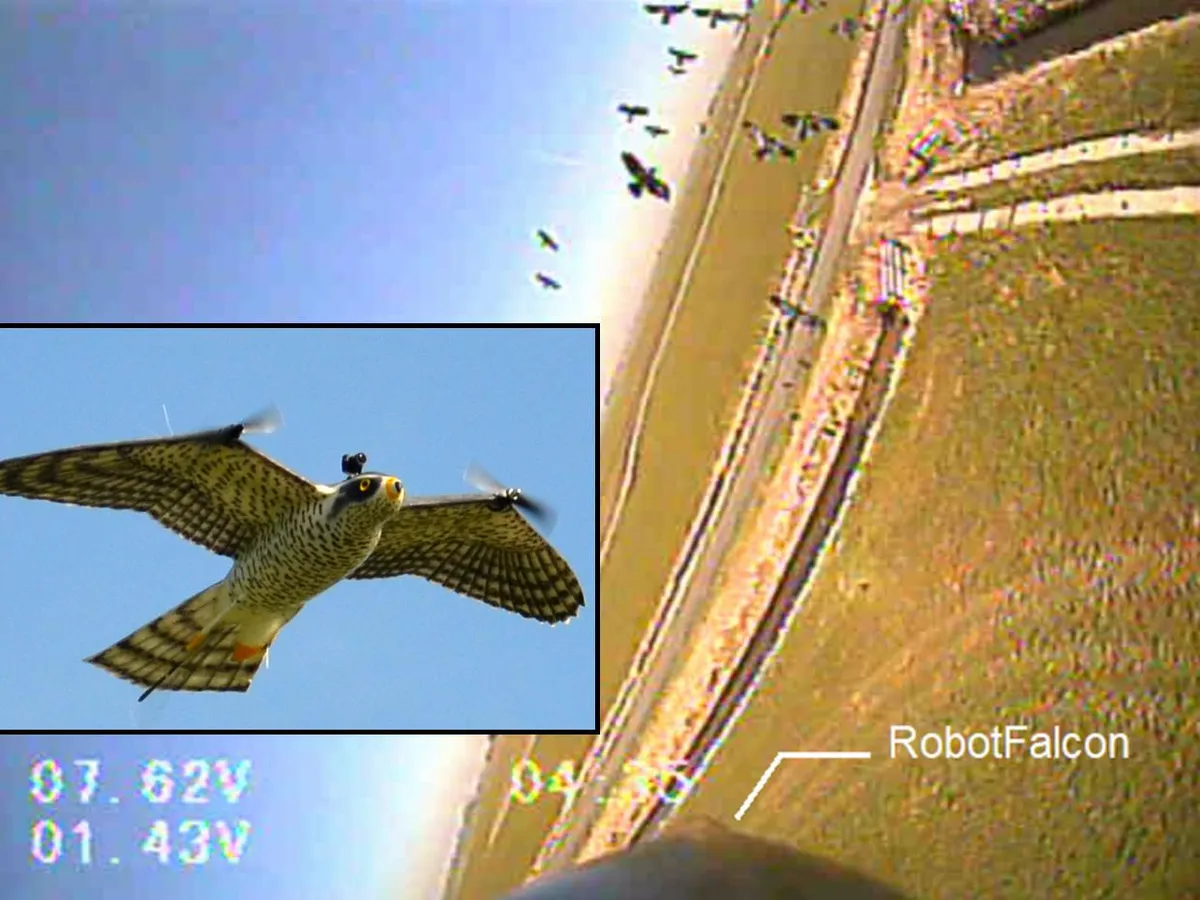
Enter the robotic falcon. Developed over several years by a research team at the University of Groningen in the Netherlands, this biomimetic drone combines expertise in animal behaviour and computational biology. The goal: create a lifelike, bird-shaped robot that could tap into avian instincts and redirect birds away from flight paths.
Constructed from lightweight fiberglass and carbon fibre, the falcon drone mimics its real-world counterpart in both size and silhouette. But instead of flapping its wings, it’s powered by twin battery-operated propellers that allow it to glide smoothly through the air at speeds of up to 45 km/h, with a flight time of up to 15 minutes.
From the ground, human operators steer the falcon via remote control, guided by a head-mounted camera that transmits its flight path in real time. The device replicates the movement of natural predators, prompting nearby birds to perceive it as a threat and flee.
The concept exploits a basic reality of animal behaviour: birds tend to habituate to conventional deterrents but retain an instinctive fear of predators. While standard drones often fail to elicit a response, the robotic falcon triggers a consistent flight response, mimicking what happens when birds spot a raptor in the wild.
The system has been field-tested across a range of locations and bird species, with encouraging results. Compared to traditional scare tactics, it showed improved effectiveness in displacing birds. Still, the researchers acknowledge some variables could influence performance—such as the variability in bird behaviour across different ecosystems, or the falcon’s reliance on specially trained operators.
Battery life remains a limiting factor, as does performance in poor weather. Low visibility or strong winds can reduce the drone’s effectiveness. There’s also the question of whether the current model can handle larger birds, such as geese. Researchers speculate that scaling up the design—perhaps by developing larger predator-mimicking drones—could address this issue, provided the concept continues to prove itself.
For now, there are other obstacles to widespread adoption. Maintenance and operational costs could strain the budgets of smaller airports. And like many disruptive technologies, the robotic falcon may face institutional resistance. Integrating novel solutions into established aviation practices—especially those governed by rigorous safety standards—takes time.
Still, this falcon may be on the verge of something significant. It offers a compelling blend of biological insight and robotics, delivering a humane, effective solution to a long-standing aviation hazard. With further refinement, it could become a mainstay of modern airfield safety strategies—bridging the gap between ecological preservation and high-tech aviation security.
References:
• IEEE Spectrum: Robotic Bird Drone Improves Airport Safety
• Royal Society: Predator-Model Robot for Bird Control